

Pop is down on one knee between the bean rows, and I am trying to stand exactly where he tells me to. The dirt is so dry it puffs when I shift my feet. The whole garden smells sharp and green, the way tomato leaves smell on your fingers.
He points. Not at me. At the ground.
A toad sits in the shadow of the bean leaves, brown as the dirt, so still I would have walked right past it. Its throat goes in and out. In and out.
“Rain by morning,” Pop says.
He says it the way other men read the weather off the evening news. Like a fact somebody already checked.
I thought that saying belonged to Pop. Years later, I would find it in old books, in the words of strangers, and feel a little less alone in missing him.
Rain by Morning
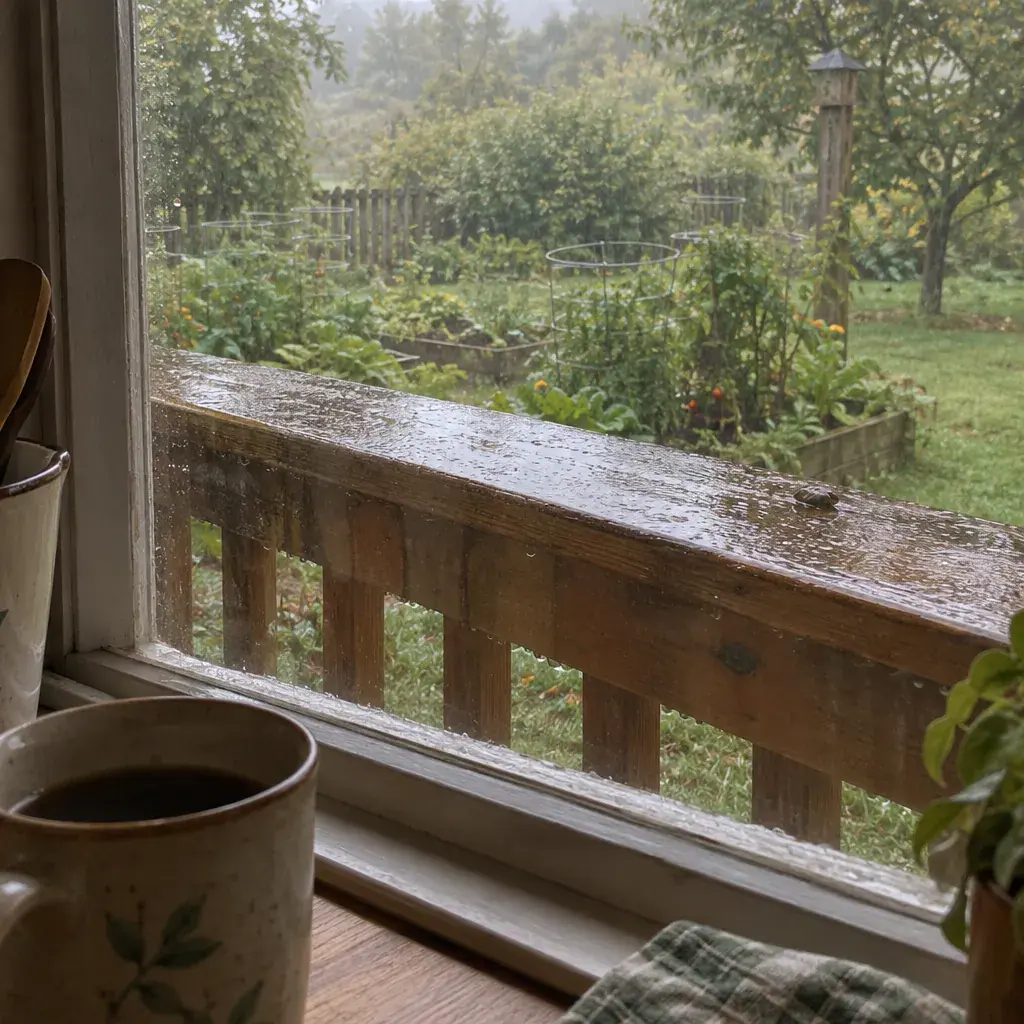
He said it all summer. For the toad in the beans, the toad on the front walk, the toad that hopped out from under the porch when we came down the steps after supper.
“Rain by morning.”
My brother and I tested him. We would run to the kitchen window at breakfast and press our faces to the glass, looking for a wet porch rail.
Some mornings it had rained. Then Pop would stir his coffee and say nothing at all, which was worse than gloating.
Some mornings it hadn’t. “That toad knew something we didn’t,” he’d say. “It’ll come.”
I can’t tell you now whether it rained more mornings than not. I was a kid. I remember the wet-rail mornings better, which probably says more about me than about the weather.
I had a private theory back then, too. I thought the little toads came down with the rain. Where else would so many come from, all at once, after a storm?
Pop didn’t hedge. That was the thing about him. He was sure, and standing next to someone that sure felt like standing somewhere safe.
Don’t Hurt the Toad

There was one rule in Pop’s garden he enforced harder than the rest. You did not hurt a toad.
Not with a stick, not with a shoe, not for a laugh. When he mowed, he’d cut the engine, get down with a groan and scoop one off the grass in both hands. Then he’d set it in the bean rows like he was putting a baby down for a nap.
I asked him why, once. He said, “Because they’re working.” He didn’t explain, and I didn’t ask again.
Years later I came across old sayings from North Carolina warning that if you killed a toad, a well or a spring would go dry. Another said the cows would go dry instead. Another just called it bad luck.
I don’t know if Pop knew any of that. I’m guessing.
But I like the idea that his gentleness had a history. That somebody once told him not to hurt the toad, with a reason he forgot and a rule he kept. And then he handed the rule to me.
Written Down by Strangers

Pop died in the winter, when the garden was nothing but bare stakes and frozen dirt.
A while after the funeral, I typed his saying into a search bar, half as a joke. I expected nothing. A gardening forum, maybe.
What I found was a set of old books. Folklorists had gone around North Carolina between 1912 and 1943, asking people what they believed and writing it down.
Page after page of weather signs.
And there it was, in plain print: “When many toads are seen, it is a sign of rain.”
Right next to it sat another one: “To step on toad is sign it will rain soon.”
The notes beside them listed cousins of the saying from Maryland, Kansas and Oklahoma, out to California and up into Ontario. In Kansas, toads came out before a rain. In California, a toad hopping around in the daytime meant rain soon.
I sat with that for a long time.
I had thought the saying was his. Something he’d worked out over a lifetime of evenings in the dirt.
It was his. It was also somebody’s in Maryland, and somebody’s in Kansas, and somebody’s in Ontario.
People he never met, watching their own ground, saying his line in their own words.
There was one more line I found, from a writer in New England in 1896. He noted that it was a common belief among children there that little toads were rained down.
I laughed out loud, alone at my desk. Me at the kitchen window. Kids in New England, long before I was born, thinking the very same thing.
The grief changed shape a little. He was gone, but his words had company. They had been passed hand to hand by people none of us knew, and they had landed on him, and then on me.
What the Toad Knows

Then I went looking for the connection. Why would a toad come out with the rain at all?
It turns out toads don’t really drink. They soak water in through their skin, mostly through a small patch on the belly.
When it’s dry, many toads dig in and wait it out underground. Rain brings them back up.
The part that got me was an experiment in Spain. Researchers buried a speaker in the sand and played the low rumble of rainfall into the ground, with no rain falling at all. Two kinds of toads came up earlier than the toads left in quiet ground.
Those toads could hear the rain through the dirt.
Those two kinds of toads were answering vibrations like rain hitting the ground. That didn’t tell me why our toad was sitting by the beans before any rain had fallen.
Half Right
That’s what I keep turning over. Pop was half right.
Toads and rain really do go together. He had that part. But the experiment didn’t tell me whether his toad meant rain by morning.
I still don’t know what brought that toad out. I think of Pop watching the garden, summer after summer, sure he knew.
And he was paying attention. That’s what I missed as a kid.
He was down on one knee in the dirt most evenings, close enough to watch a toad’s throat move. He knew which corner stayed damp. He knew where the toads liked to sit.
I can’t count on his saying for a forecast. But I can hear in it a man who looked.
And it holds his voice. I can’t hear him in a photograph. I can hear him in three words.
The Toad by the Back Steps
Last summer, a toad turned up by my back steps. Brown as the dirt. Throat going in and out.
My daughter crouched down next to it, the way I used to.
I heard myself say it before I’d decided to. “Rain by morning.”
She looked at the sky. Clear. Then she looked at me like I’d lost it.
It didn’t rain. I told her the toad knew something we didn’t.
Maybe your family has a line like this. A knee that aches before a storm, a saying about the cows lying down, a red sky at night.
Say it out loud. Say it to someone small. Let them roll their eyes at you.
It’s weather. It’s lore. It’s him.
Rain by morning.
If an older relative still says a line like Pop’s, ask them who taught it to them, while you can. Generational Journeys is an e-book of 170 interview questions to ask relatives.