Picture a baby propped up for the camera, solemn and very still, and behind the baby a shape draped in heavy cloth. It has the outline of a person. It might be a chair. It looks, frankly, a little like a ghost.
It isn’t. Usually the shape is the baby’s mother, hidden under a cloak or a curtain so her child would sit still long enough for the picture. The artist Linda Fregni Nagler collected so many of these images that she showed 997 of them as a series called The Hidden Mother at the 55th Venice Biennale in 2013. Behind each one was a family that wanted a picture of their child badly enough to hide in plain sight.
An unlabeled baby picture in a family box can look like the least useful photo you own. There’s no name, and the face could be anyone’s. But the photo is evidence.
The type of image, the card it’s mounted on, a tax stamp, the studio’s name and even the baby’s dress can narrow when and where it was taken. None of these clues names the baby on its own. Together they can shrink the list of ancestors it could be.
1. The kind of photograph dates it before you look at the baby
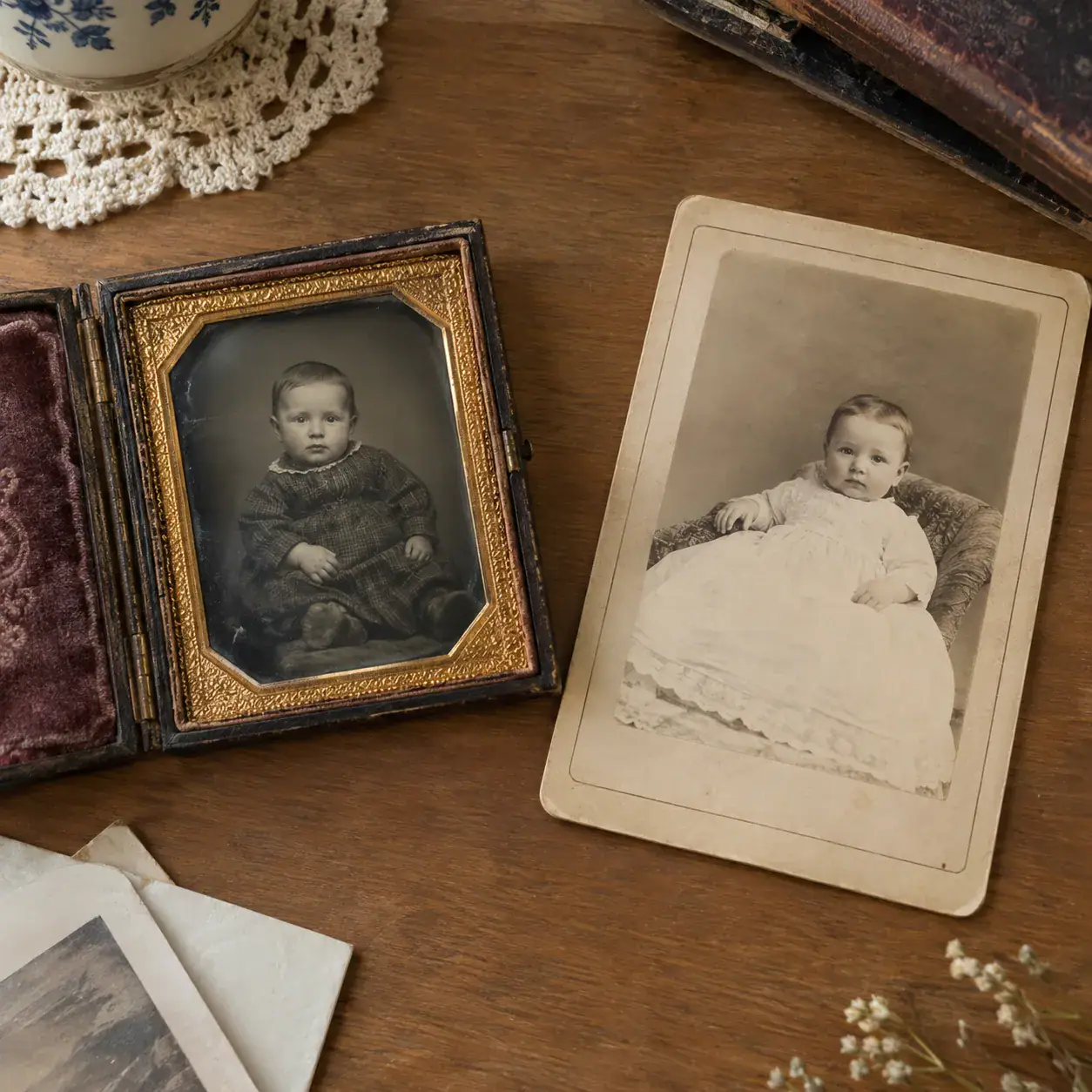
Start with what the image is made of, because each photographic process had its years.
Nicolette Bromberg, curator of photography at the University of Washington’s Special Collections, gives these ranges of use:
- Daguerreotype (an image on a polished metal plate): 1839 to 1865, peaking in the 1850s and generally found in a case
- Ambrotype (an image on glass, backed in black): 1854 to 1865, also generally cased
- Tintype (an image on a thin iron sheet): 1856 to 1930, peaking in the 1860s
- Carte de visite, or CDV (a small paper print on a card about 4 by 2.5 inches): 1860 to 1900, popular from the 1860s
- Cabinet card (a larger paper print on card): 1866 into the 1900s
So a baby on a cased glass plate most likely dates from the 1850s or early 1860s. A baby on a cabinet card points to the late 1860s or later.
These are ranges of use, not proof. Tintypes ran for decades, so a tintype on its own leaves a wide window.
What the format gives you is a starting bracket, and every clue after this one works inside it.
2. The card it’s mounted on narrows the decade
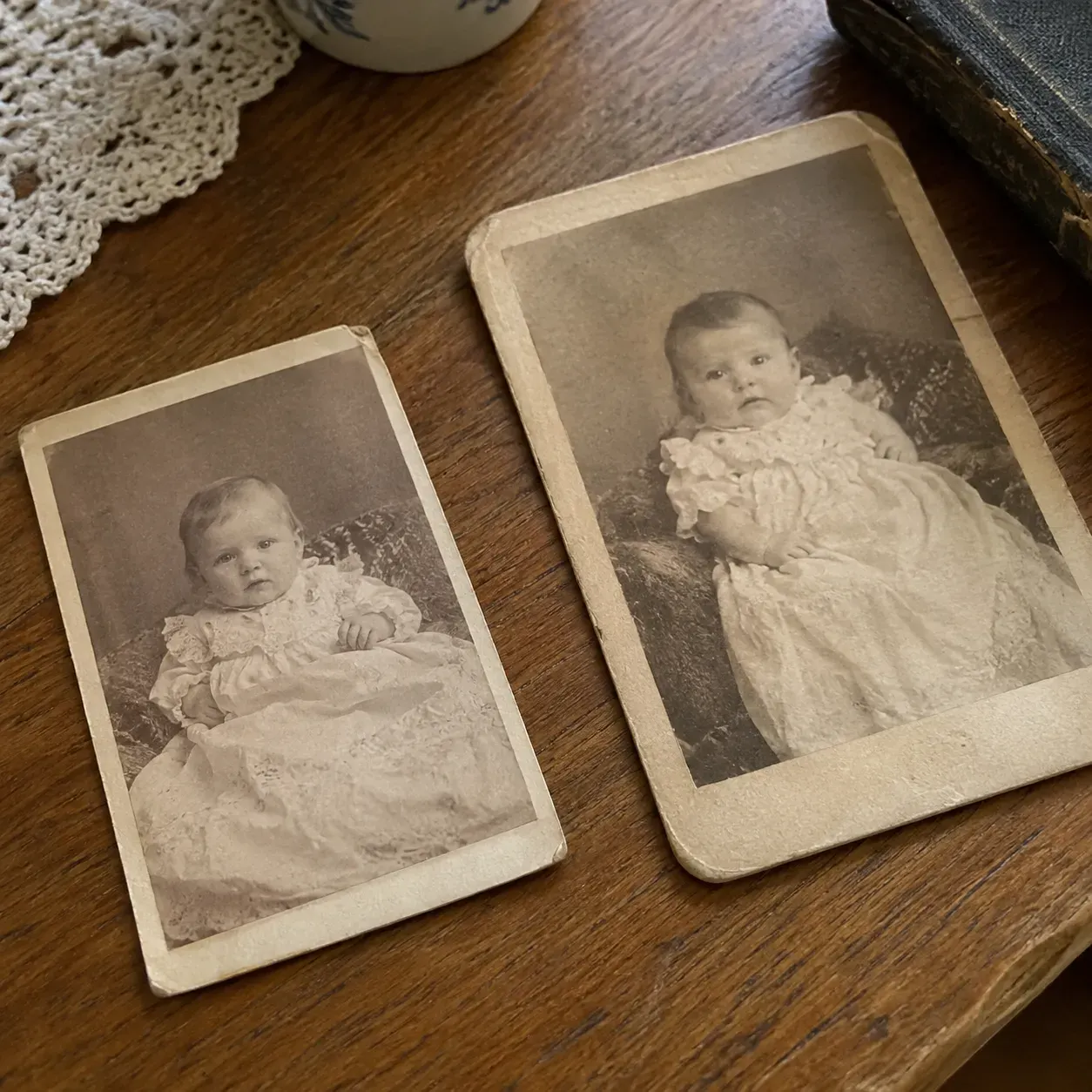
Paper photographs were glued to card, called the mount, and mounts changed with fashion. Colin Harding of the National Science and Media Museum sets out two simple rules for cartes de visite.
Early cartes from the 1860s usually have square corners, and mounts with rounded corners came in during the 1870s. And generally, the thinner the mount, the earlier the photograph.
British photo-dating guides go finer than that, with rough ranges for card thickness and colour. White, cream and grey mounts, for example, are placed roughly in the late 1850s to early 1860s.
Treat those as rough guides built from British photographs. American mount fashions may not have matched.
There’s also a catch that every mount guide carries. Many photographers, especially in remote areas, used up old mounts until their stock ran out.
A square-cornered card in a small-town studio may be later than it looks. Use the mount to narrow the decade, and let a firmer clue settle the year.
3. A small stamp on the back can pin it to two years
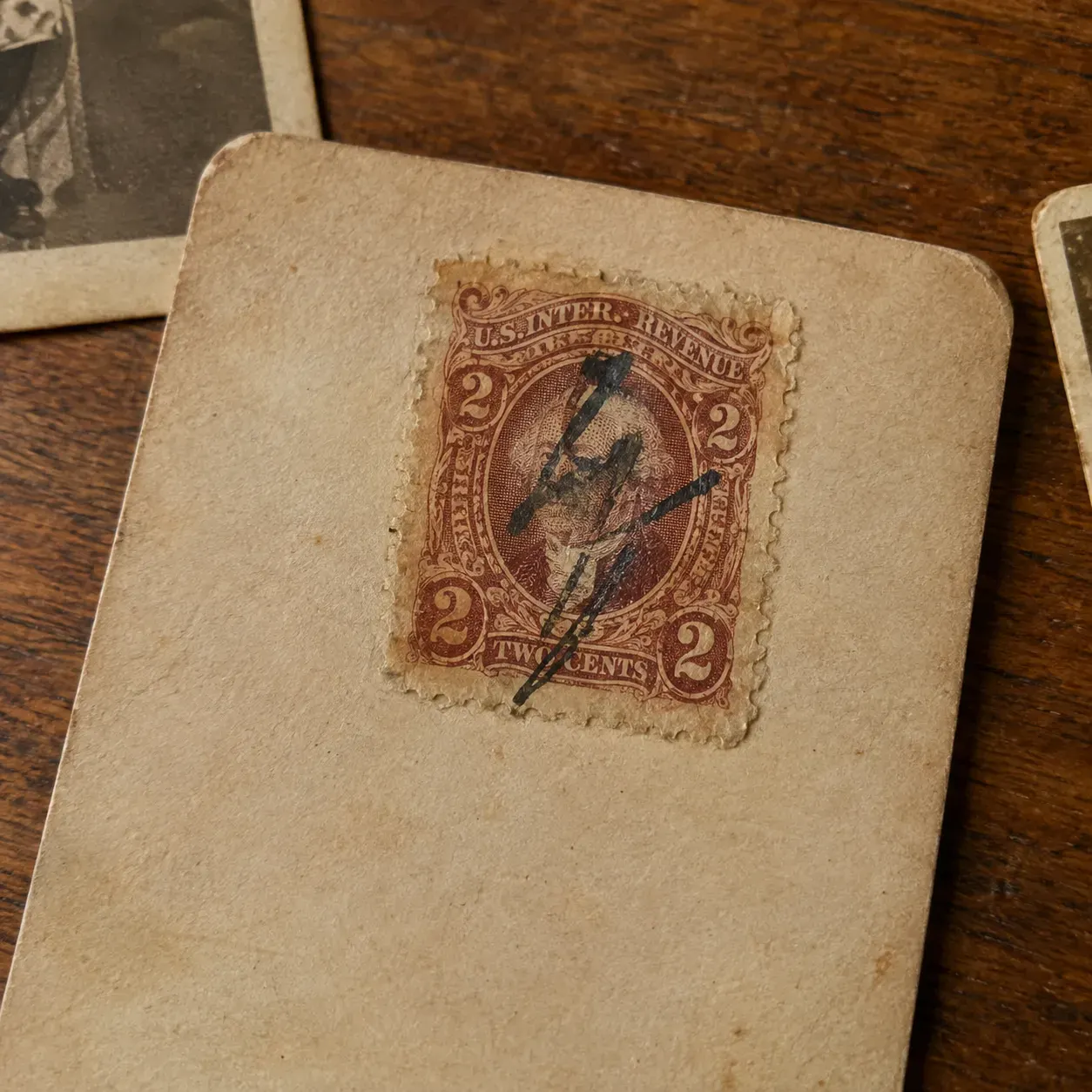
Turn a CDV over. If there’s a postage-size stamp on the back, often with initials or a date written across it, you may be holding a photo you can date to within two years.
If the photo was taken in the US, that stamp points to the federal photograph tax, in force from August 1, 1864, to July 31, 1866. Photographers had to put tax stamps on the backs of paper and plate images during those years.
There was no special photograph stamp, so they used existing revenue stamps, such as those meant for proprietary goods, playing cards or bank checks.
They cancelled each one, usually with their initials and often with a date. One survey of 867 cartes de visite looked at exactly how they did it.
The stamp also hints at the price. According to the Hood River County History Museum, a 2-cent stamp indicates the photo cost 25 cents or less, and pricier photos took higher stamps. That tells you something about what the family chose to spend on a picture of their baby.
One caution: no stamp doesn’t rule out those years. Stamps were sometimes removed, and not every photo or format was stamped. A stamp can narrow the date to two years, but its absence proves nothing.
4. The photographer’s name tells you where your family was
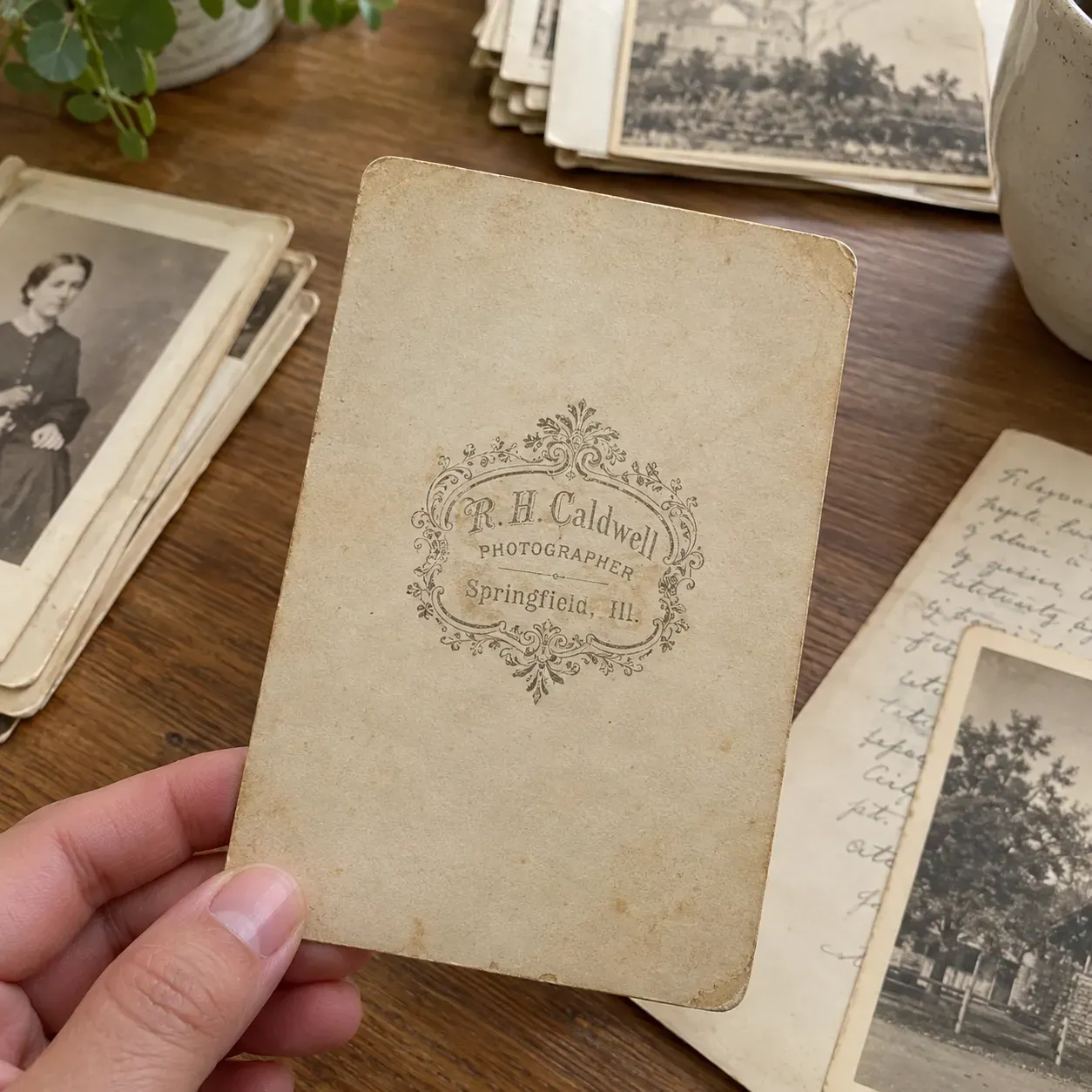
Many studio photos carry the photographer’s name and address, often printed on the back of the mount. This is called the backstamp or imprint. Harding notes it “can be very helpful,” and for a genealogist it matters because it ties the baby to a place.
Look the studio up. Published photographer directories exist for this, and one example is Diane VanSkiver Gagel’s Directory of Photographers in the United States 1888 & 1889 and Canada 1889.
The Ontario Genealogical Society also offers an Ontario Photographers List covering 1901 to 1925.
City directories, the annual lists of a town’s residents and businesses, can show the years a studio operated at a given address. If the backstamp shows an address the studio only used for a few years, your date range shrinks again.
Then match the place to your tree. If you know a branch of the family lived in that town during the studio’s years, that branch becomes the first place to look for the baby.
Keep the line clear, though. The studio shows where the photo was taken, not necessarily where the family lived. Families travelled to town studios, so the imprint suggests the family was in or near that place.
Not every studio can be traced. One genealogist writing in 2014 found that the studio named on her postcard simply wasn’t showing up online.
5. A postcard back can date a baby photo to within a few years
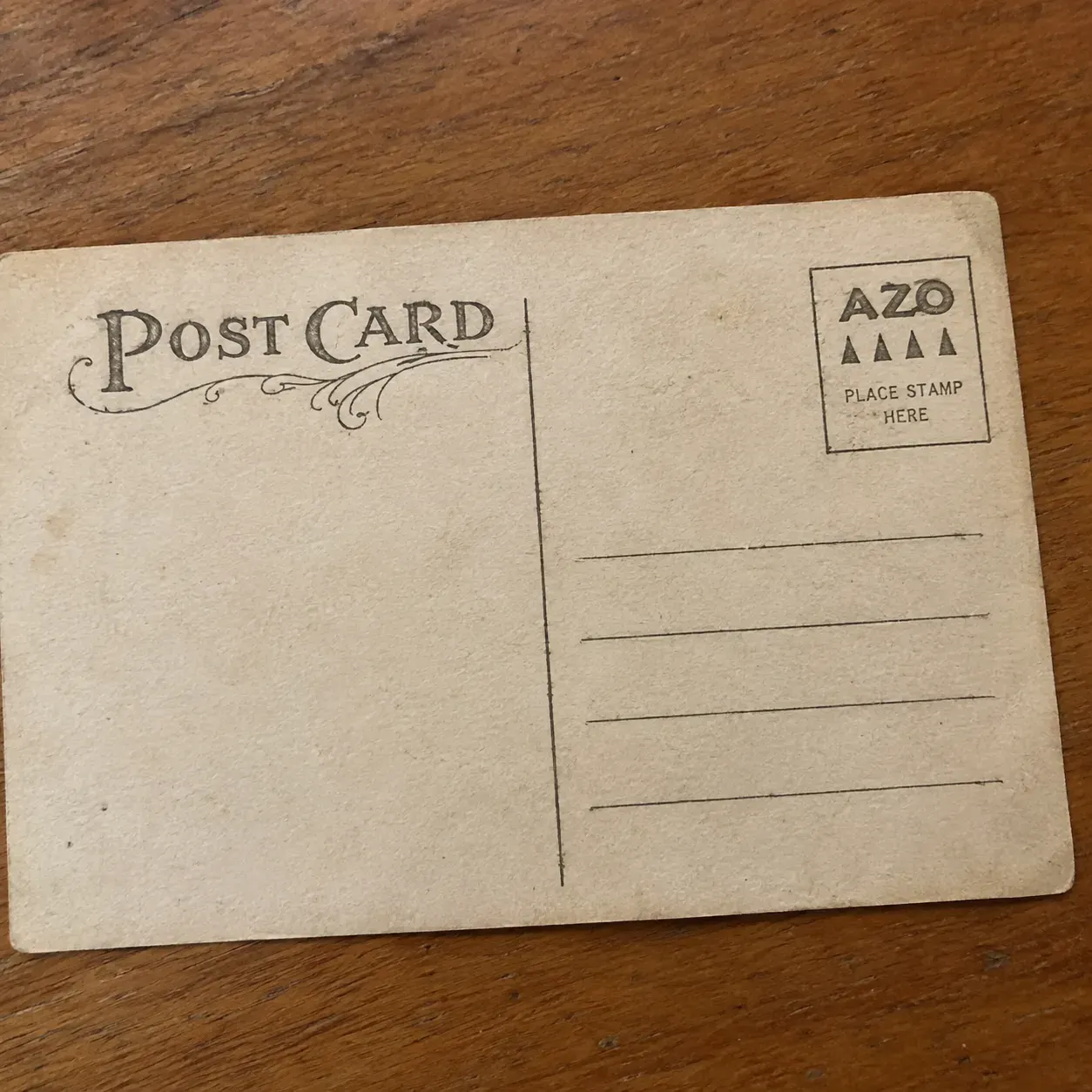
In the early twentieth century, many families had baby pictures printed as real photo postcards, or RPPCs. These were actual photographic prints made on paper with a postcard back, not printed copies. The back of that card has its own dating clues.
For US postcards, the University of Washington handout gives this timeline:
- “Private mailing card”: 1898 to December 24, 1901.
- “Postcard” with an undivided back, where the message went on the front: December 24, 1901, to 1907.
- “Postcard” with a divided back, so the message goes on the back: 1907 onward.
For a postcard produced for the US market, a divided back generally points to 1907 or later. Other countries allowed divided backs earlier, so establish the card’s country before using this clue.
Then look at the stamp box, the printed square where the postage stamp goes. Photo paper makers printed their brand there, with Velox appearing from 1902 and Azo from 1904.
An AZO stamp box with four triangles pointing upward generally points to the 1900s to 1910s, though guides differ on the exact years. Use the back layout and stamp box together, allowing for the card’s country of origin.
If the card was mailed, read everything else too. The message, the addressee and the postmark show who received the baby’s picture, when and where. That’s a recipient you can investigate for a possible family connection.
6. A snapshot means someone had access to a camera
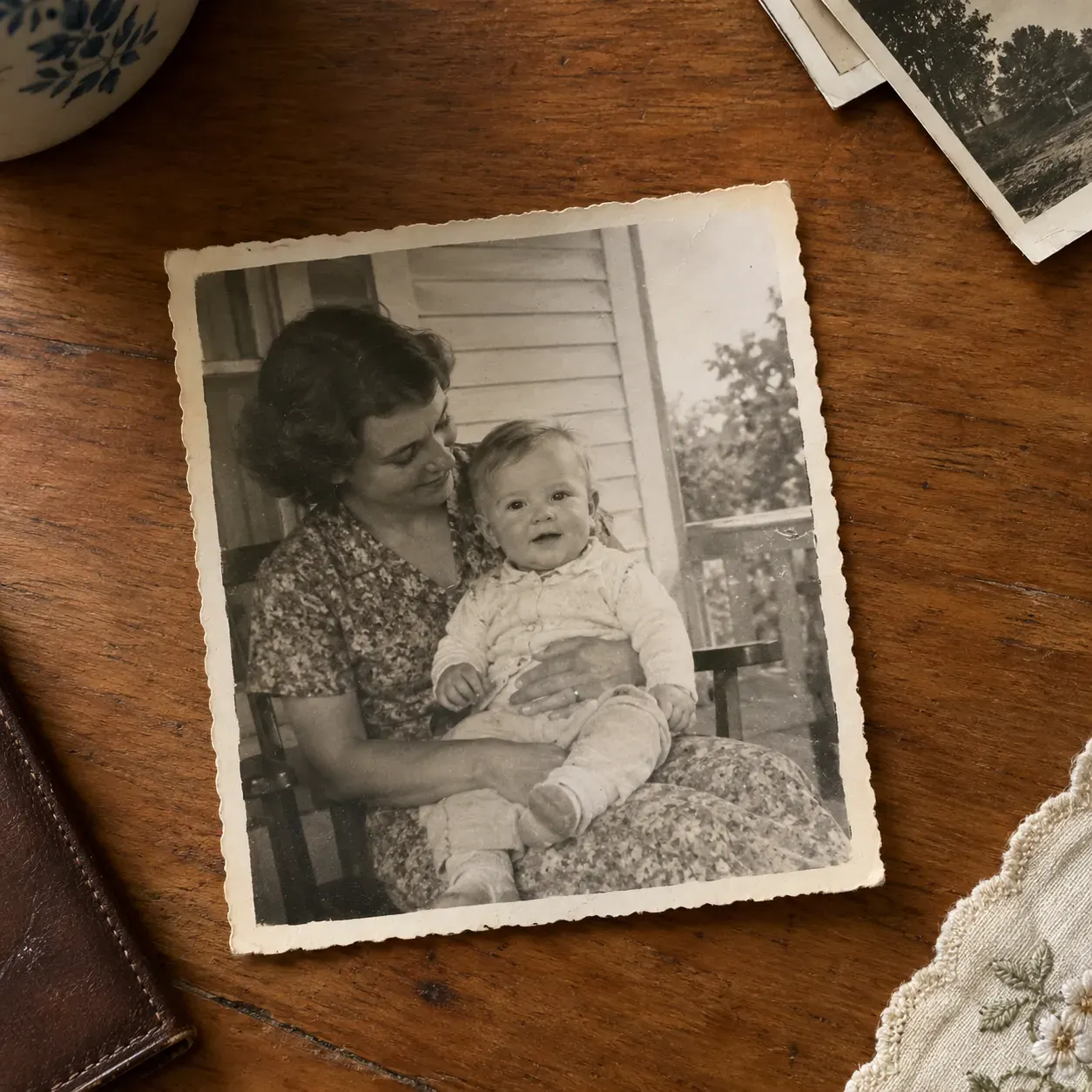
Not every old baby photo came from a studio. An informal shot of a baby on a porch or in a garden is a snapshot, and snapshots have their own timeline.
Kodak’s first cameras made circular prints. The original Kodak of 1888 produced round prints about 2½ inches across, and the Kodak #2 of 1889 made 3-inch ones.
So a round snapshot points to 1888 or later.
In February 1900 Kodak launched the Brownie, priced at $1, and reportedly sold 150,000 in the first year. Prints with wavy, scalloped “deckle” edges are a mid-twentieth-century style.
A relaxed snapshot of a baby at home generally postdates 1888 to 1900. It also suggests that the family, a relative or a neighbour had access to a camera.
It doesn’t prove your ancestors owned one. Whoever took it was close enough to be in the house that day, which makes them worth wondering about.
7. That shrouded figure is probably the baby’s mother
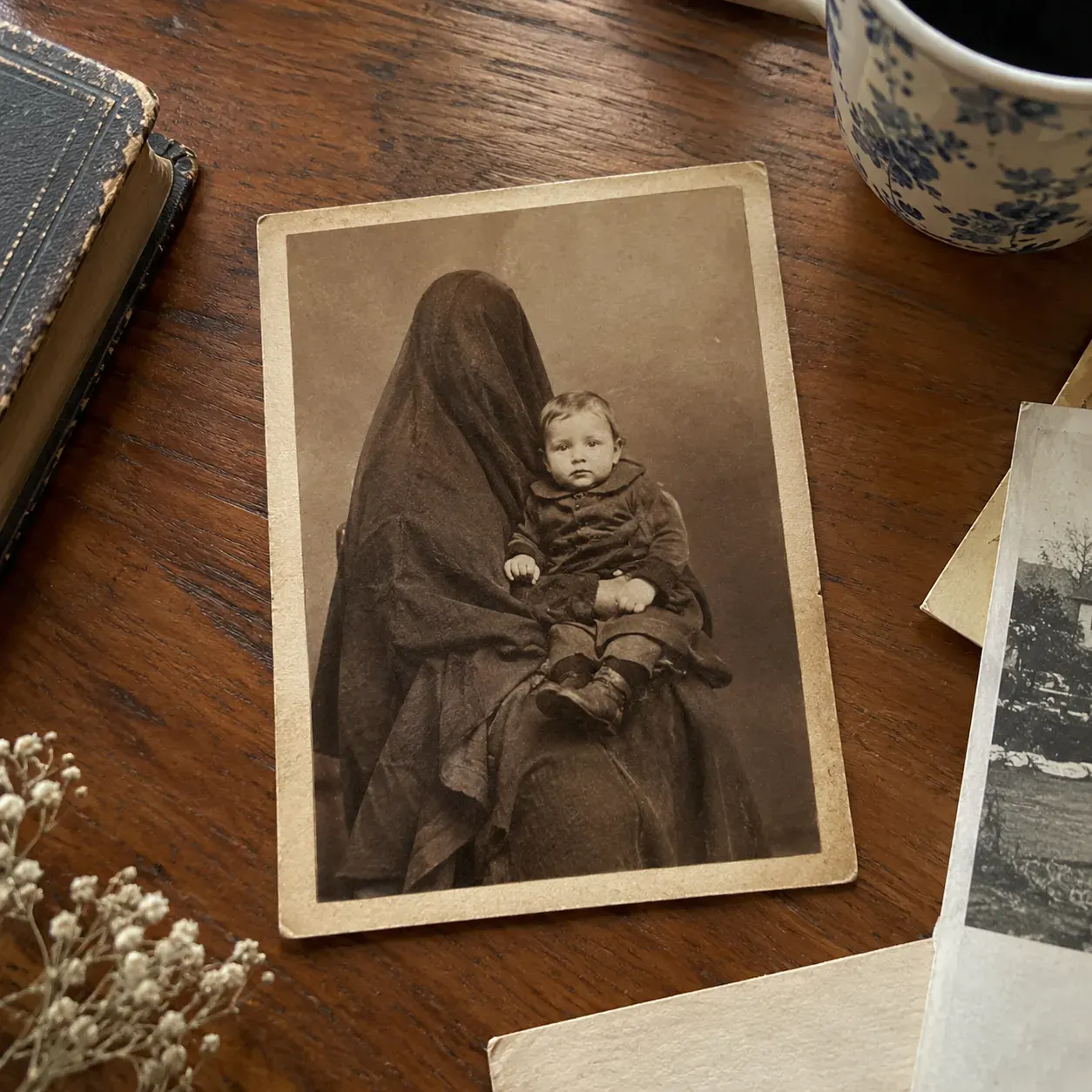
Back to the ghost. Hidden mother photography arose because early cameras needed long exposures. Early daguerreotypes took anywhere from tens of seconds to several minutes, and no baby sits still that long on their own.
So an adult held the child and hid. They crouched behind curtains, sat under cloaks or were disguised as chairs. Sometimes they stood to one side and were cropped out or covered by the mat, the card frame around the image.
The practice ran from the 1840s through the 1920s and faded away as cameras became common and exposures got faster.
The hidden figure was usually the mother, though sometimes it was the father, a nanny or the photographer’s assistant. So you can say a parent’s hand or lap is likely in the photo. You can’t say for certain whose.
If a mat or frame covers the edges, a photograph conservator may be able to reveal more of the person safely.
Do not dismantle an original cased photograph yourself. Sometimes the only image you have of an ancestor is a draped arm holding their child.
8. A dress doesn’t mean it’s a girl
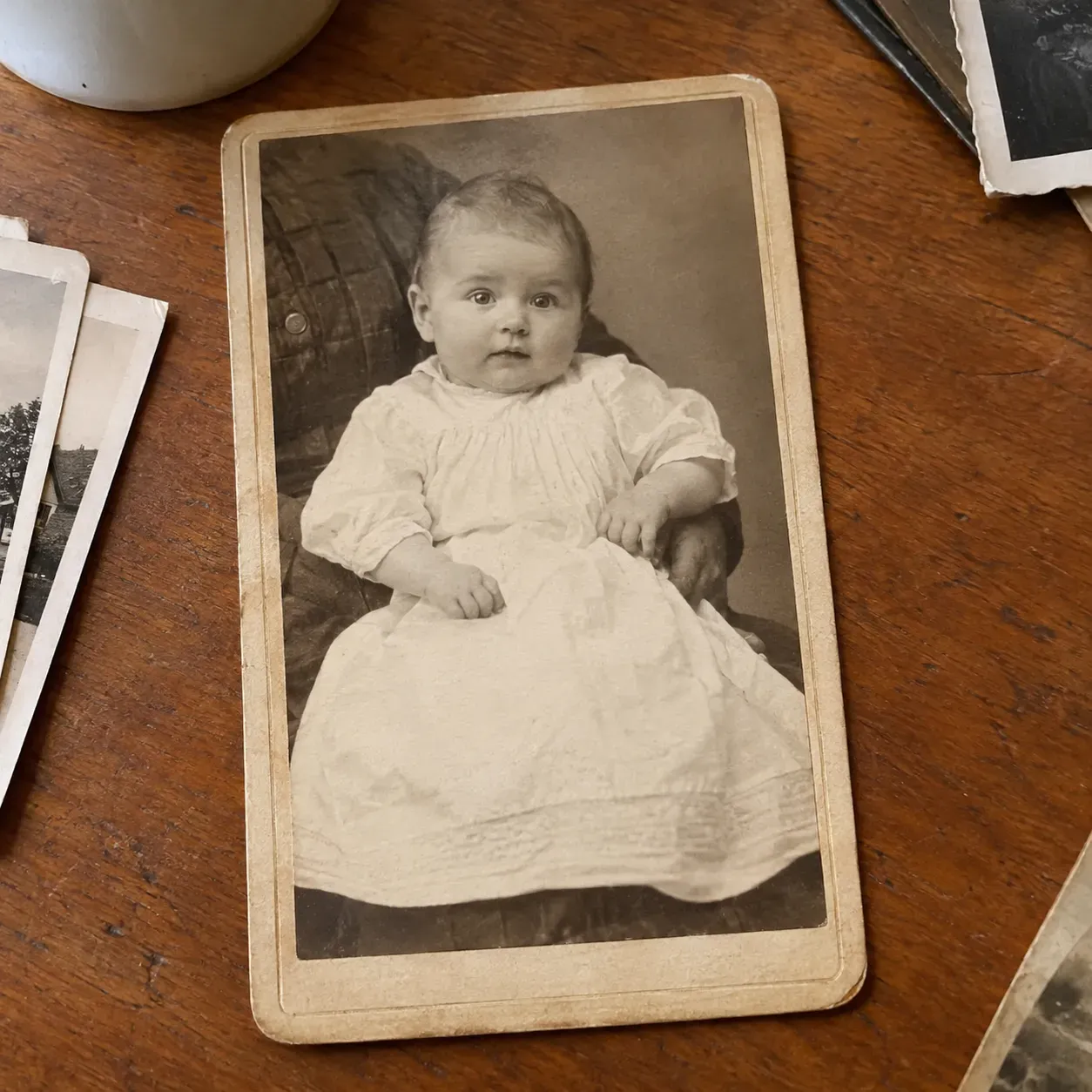
This is the misreading that sends people down the wrong branch. You see a baby in a long white dress and write “Aunt Mary” on the back. It could just as easily be Uncle John.
In the US, historian Jo B. Paoletti has found that male and female infants wore identical white dresses until World War I.
As she put it, “it was not considered important to differentiate boys and girls at such an early age.”
Pink and blue for babies wasn’t common in the US until the 1920s. In a black-and-white photo you can’t see colour anyway, but the point still matters when a hand-tinted photo or family lore says “she’s in pink.”
There are a few weak hints. An 1895 Ladies’ Home Journal noted that little boys’ dresses buttoned up the front and their sisters’ fastened at the back.
That was advice from one magazine, not a rule every family followed. A dress alone does not establish the child’s sex or exact age.
9. The length of the dress hints at the baby’s age
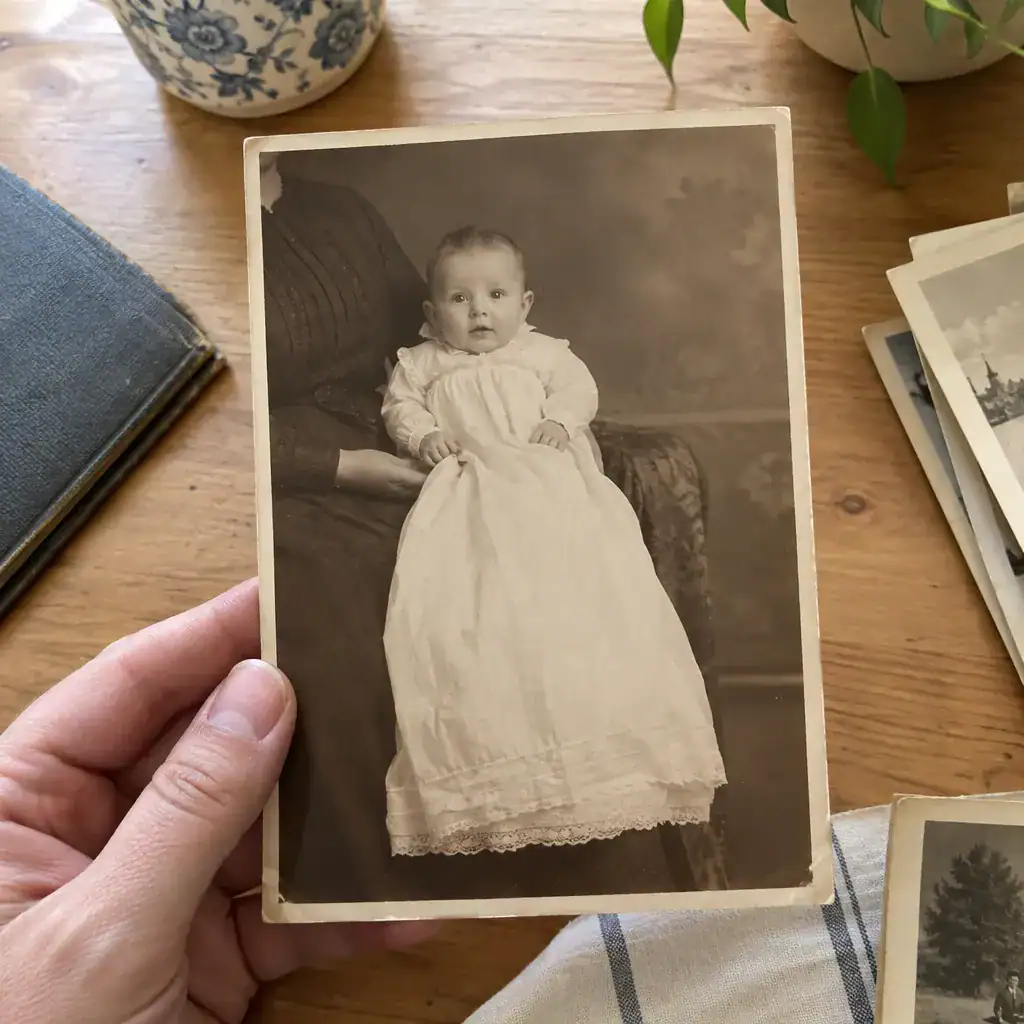
The dress can’t give you the sex, but it can give you a rough age. Paoletti describes a sequence.
Infants of both sexes wore long white dresses until they began to walk, then short, loose dresses until about two or three. Children often stayed in dresses to five or six.
For boys, the change to trousers was called breeching, and when it happened was left to the mother’s discretion.
The Library Company of Philadelphia puts boys’ move to knickerbockers and a haircut at about five to seven, often when they started school.
Families varied. Of two Morris brothers in the Library Company’s example, one had his hair cut around age three, while another kept long hair until about five. By 1900, little boys in dresses beyond two or three were becoming rarer.
Here’s why that matters. A very long gown suggests a baby not yet walking, and if you’ve dated the photo from its mount or stamp, you can estimate the birth year and check which children in the family were born then.
It works the other way too. Know the birth years, and the dress length helps you date the photo. It’s a hint with family-by-family variation, not a rule.
10. A christening gown can link generations
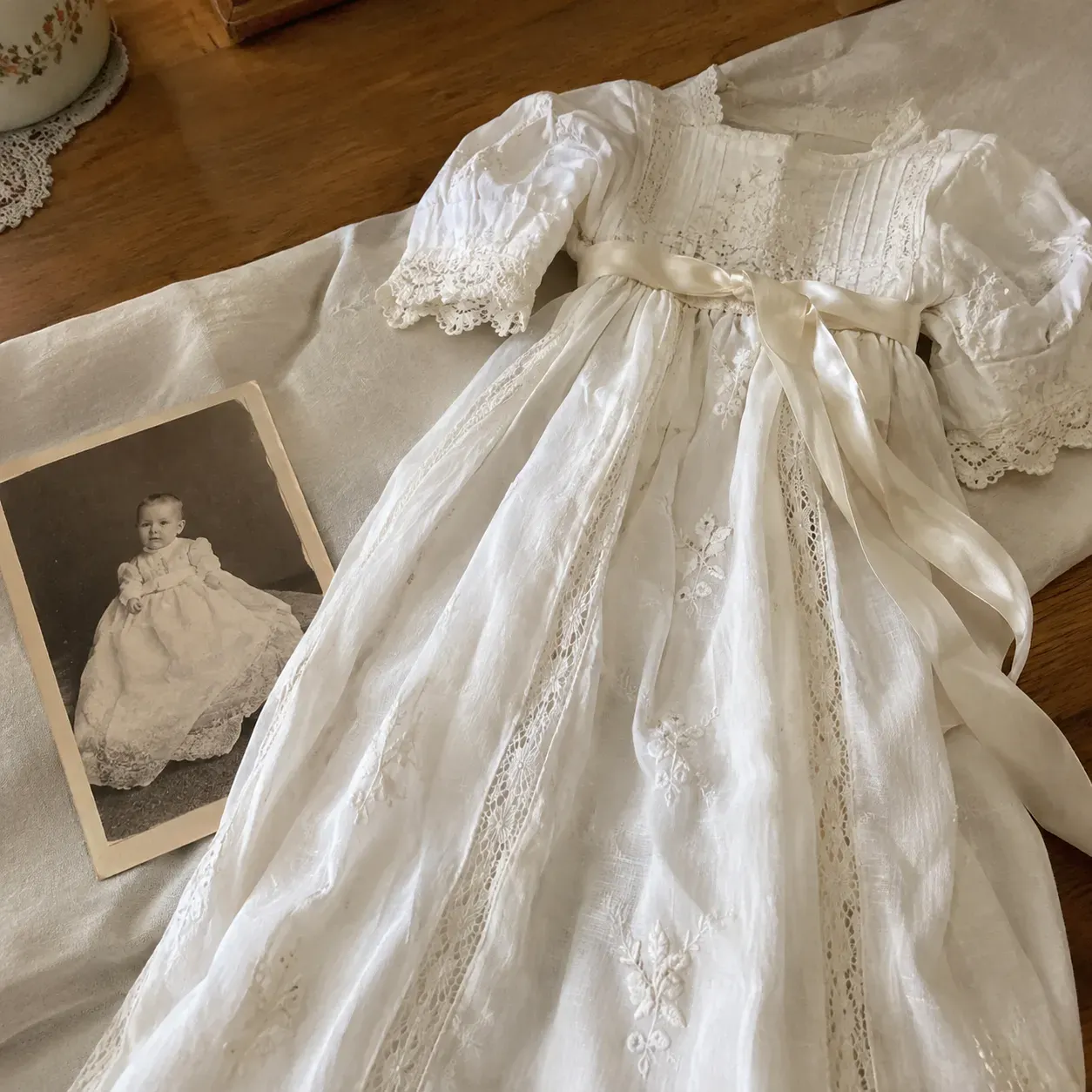
A long, elaborate white gown with lace may be a christening gown. These gowns were worn by boys and girls alike, and families kept them for the next baby.
The Victoria and Albert Museum holds one, made in England between 1900 and 1920, in white linen trimmed with embroidery, lace and ribbon. Its nickname is “The Bin Dress,” because someone rescued it from a dustbin in the early 1930s.
From then until 1979 it was used for numerous christenings in the family, for boys and girls. It was not used for a son born around 1974, the museum notes, presumably because some families had come to feel a boy shouldn’t wear a gown.
For your own photos, that suggests two things. A christening gown suggests, though it doesn’t prove, a baptism around the date of the photo.
That points you to church baptismal registers as a record to check, if the family’s church kept them and they survive. And if you spot the same gown in photos of different babies, those photos likely belong to the same family, perhaps across generations.
11. Some baby photos are memorials, and most aren’t
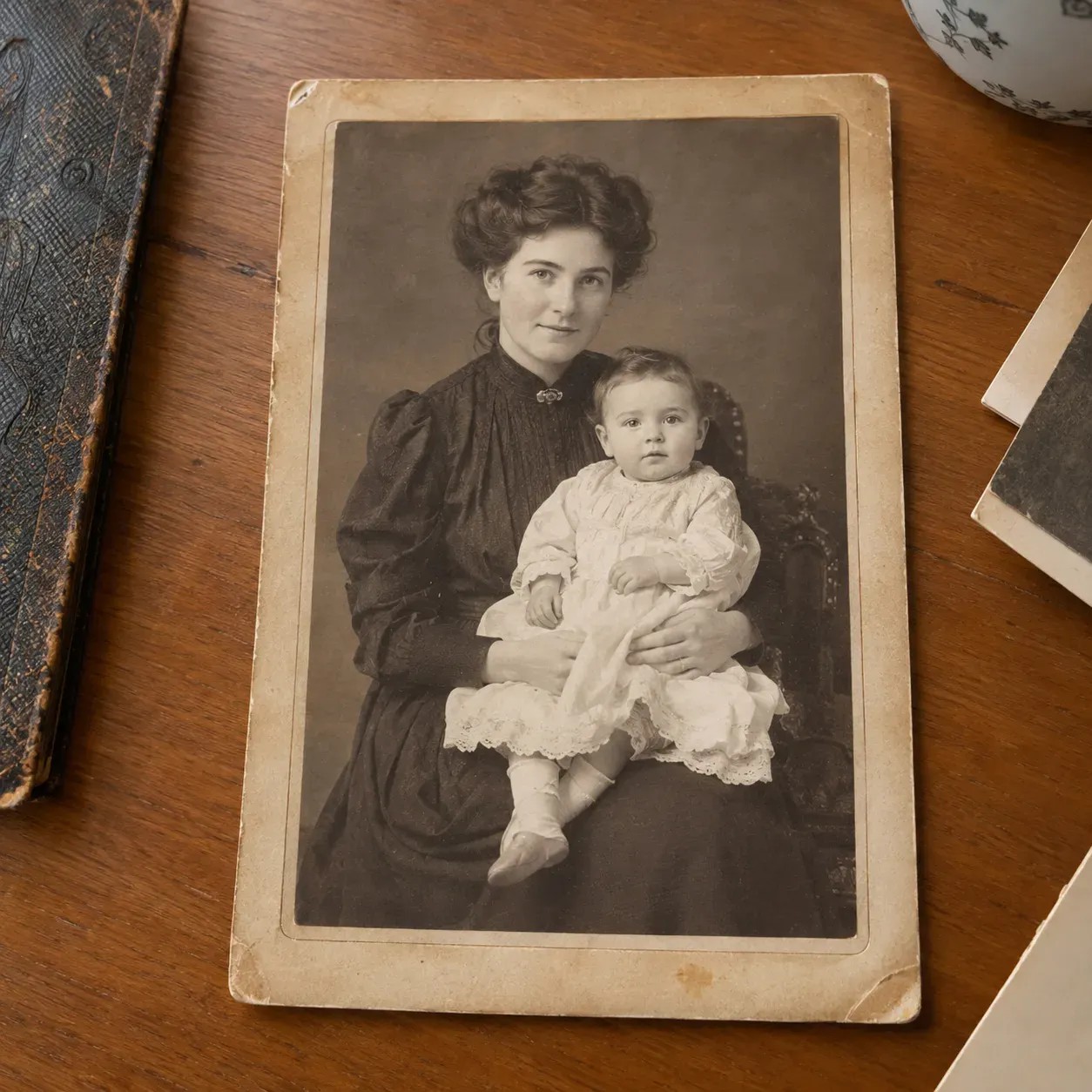
Families did sometimes photograph babies who had died. It’s worth knowing what those photographs actually look like, because a popular myth gets them wrong.
Infant death was common. In the US at the beginning of the twentieth century, roughly 100 of every 1,000 babies born alive died before their first birthday, according to the CDC.
For many families, a photograph taken after death was the only one they would ever have of that child.
Maureen A. Taylor, known as the Photo Detective, has noted that a photograph of a baby in a carriage from the 1860s might not be a birth announcement but a death card. In her words, “dead infants were commonly photographed in carriages” in that period of high infant mortality.
Genuine memorial portraits usually show the child lying down at rest, in a coffin, on a bed or on a couch, often with flowers. The metal posing stands seen in many old photos were not for propping up bodies.
Susan Higginbotham, writing on postmortem photography, explains that they “were used to help living people remain still.” Her test is simple: “If a person looks alive, he or she is.”
A posing stand is not evidence of death, and a supporting parent alone cannot settle whether a portrait was taken before or after death. Memorial photos are a distinct minority of surviving nineteenth-century photographs.
If a photo in your collection does look like a memorial, treat it as a cue to search for a death or burial record for a child in that family, around the date the photo suggests. And treat it with the care the family gave it.
12. The writing on the back is evidence too, but check who wrote it
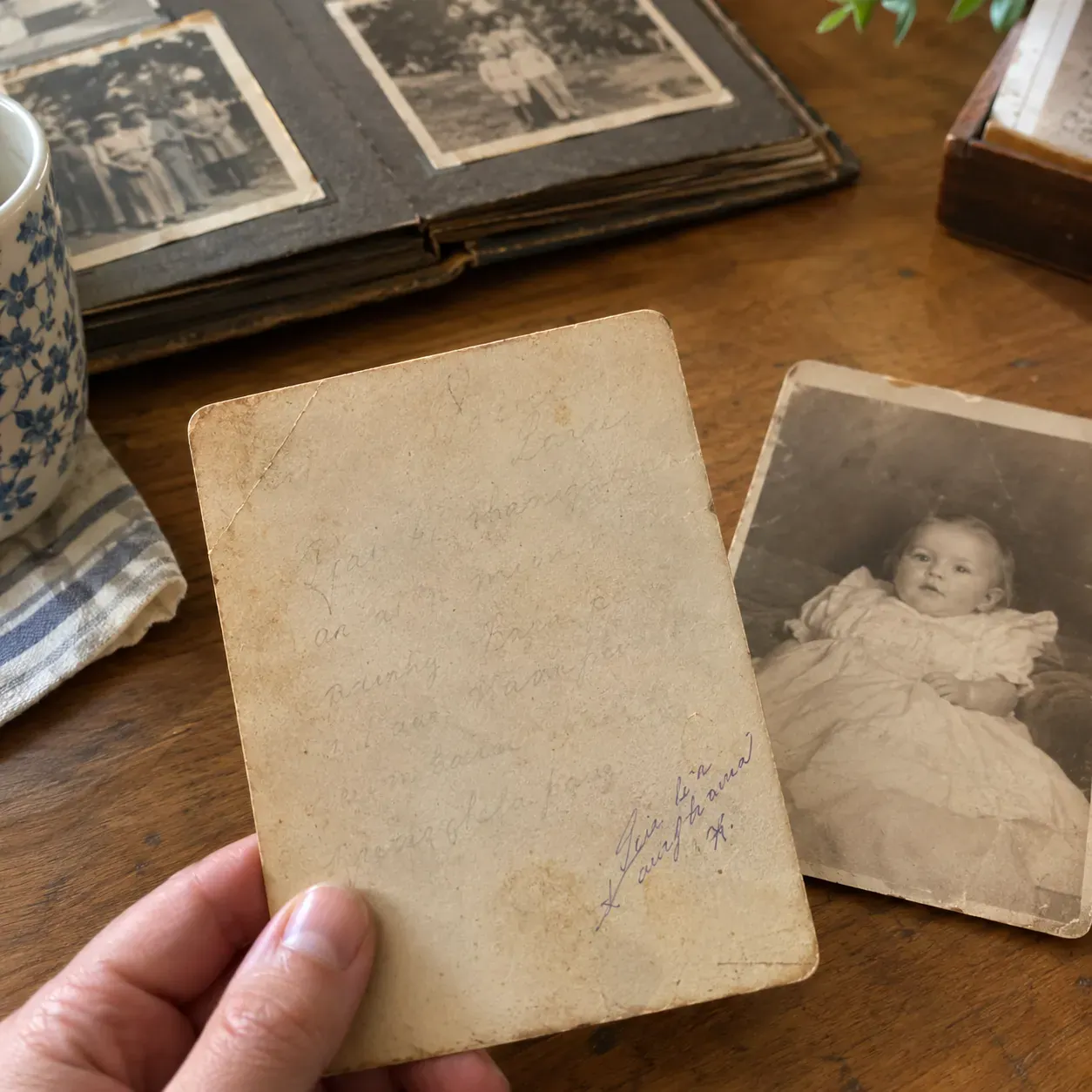
A name on the back feels like the answer. It’s actually one more piece of evidence, and it’s only as good as the person who wrote it.
Labels were often added years later by someone other than the people in the picture. Genealogist Michael John Neill has a good example from his own family.
As a teenager in the early 1980s, he labelled one of his grandmother’s photos “Dad and Pigs,” using her name for his grandfather, Cecil Neill. Nobody who would have called Cecil “Dad” wrote that label, which leaves a puzzle for whoever finds it later. As Neill puts it, “things may not always be what they seem.”
So treat a label as a lead. Ask whose handwriting it is, when they wrote it and what they were likely to know. If several people wrote on the same photo, work out each hand separately.
There’s also a reason to look beyond your own box. Cartes de visite were made to share.
In the 1860s, collecting them became a craze known as “cartomania,” and Queen Victoria’s own collection ran to over one hundred albums. Families traded cartes with relatives and friends and kept them in albums.
That means copies of the same baby photo may survive in a cousin’s album, and one of those copies may carry a name. It may not, but it’s worth asking.
Start with the back of the photo
Before you clean, reframe or even handle the photo much more, record everything on the back and the mount. Note the stamp, the studio imprint and address, any writing, the corners and the colour of the card. Then put it next to one photo from the same family that you can already date, and see what matches.
Some of what that record can’t settle, a living relative might: whose gown it was, which branch went to that studio, who kept the album. If you’d like help with what to ask, Generational Journeys is an e-book of 170 interview questions for drawing family stories out of relatives.