

In the autumn of 1880, a salesman walked into Frank Woolworth’s store in Lancaster, Pennsylvania, with German glass ornaments to sell. Woolworth told him Americans wouldn’t waste money on them. They didn’t “do” anything.
He took one case of 144 anyway, on sale or return. They were gone in under a day.
That’s the thing about the box of ornaments that gets handed down in a family. You lift the lid on old tissue paper and a tangle of hooks, and there isn’t a label or a date anywhere. It’s still a record.
A German glassblower could make about 600 ornaments a day. By 1940, one American machine was turning out about 300,000. Hallmark’s first line had just 18.
The pieces in your box can tell you which Christmases they hung through, if you know what you’re looking at.
1. The Paper-Thin Glass Ones From Germany
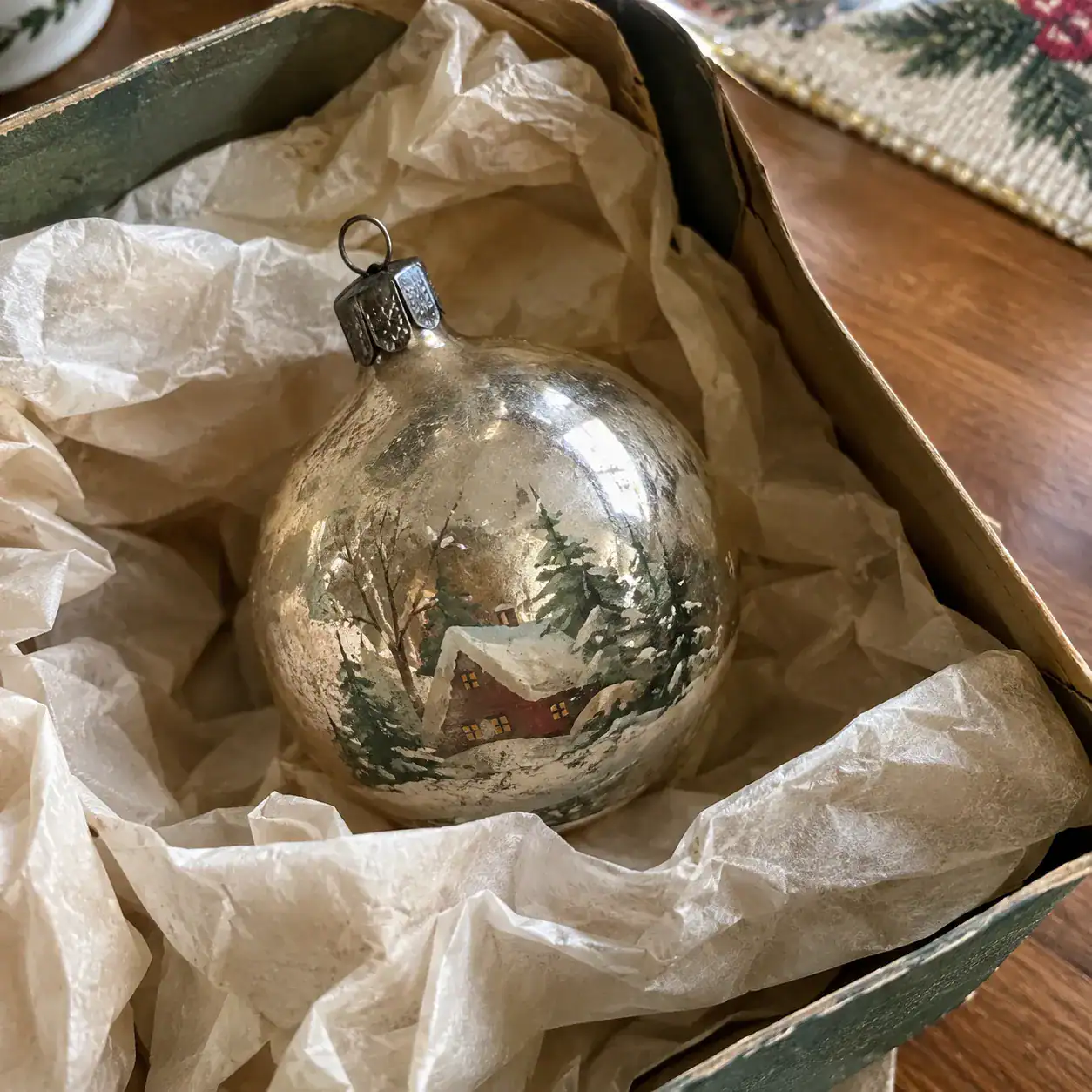
The lightest ornaments in the box, the ones that feel like holding a soap bubble, go back to Lauscha, Germany. Glass baubles were first made there, with a silver nitrate solution swirled inside for the mirror shine.
Woolworth wasn’t the first to bring them to America. He’s the man who put them in the five-and-dime and on ordinary trees. The next year he doubled the order and sold out again.
By the 1920s, European imports made up 99% of the 50 to 80 million ornaments sold in the United States each year. If your family had a tree back then, the glass on it had almost certainly crossed an ocean first.
2. The Gold Cardboard Animals
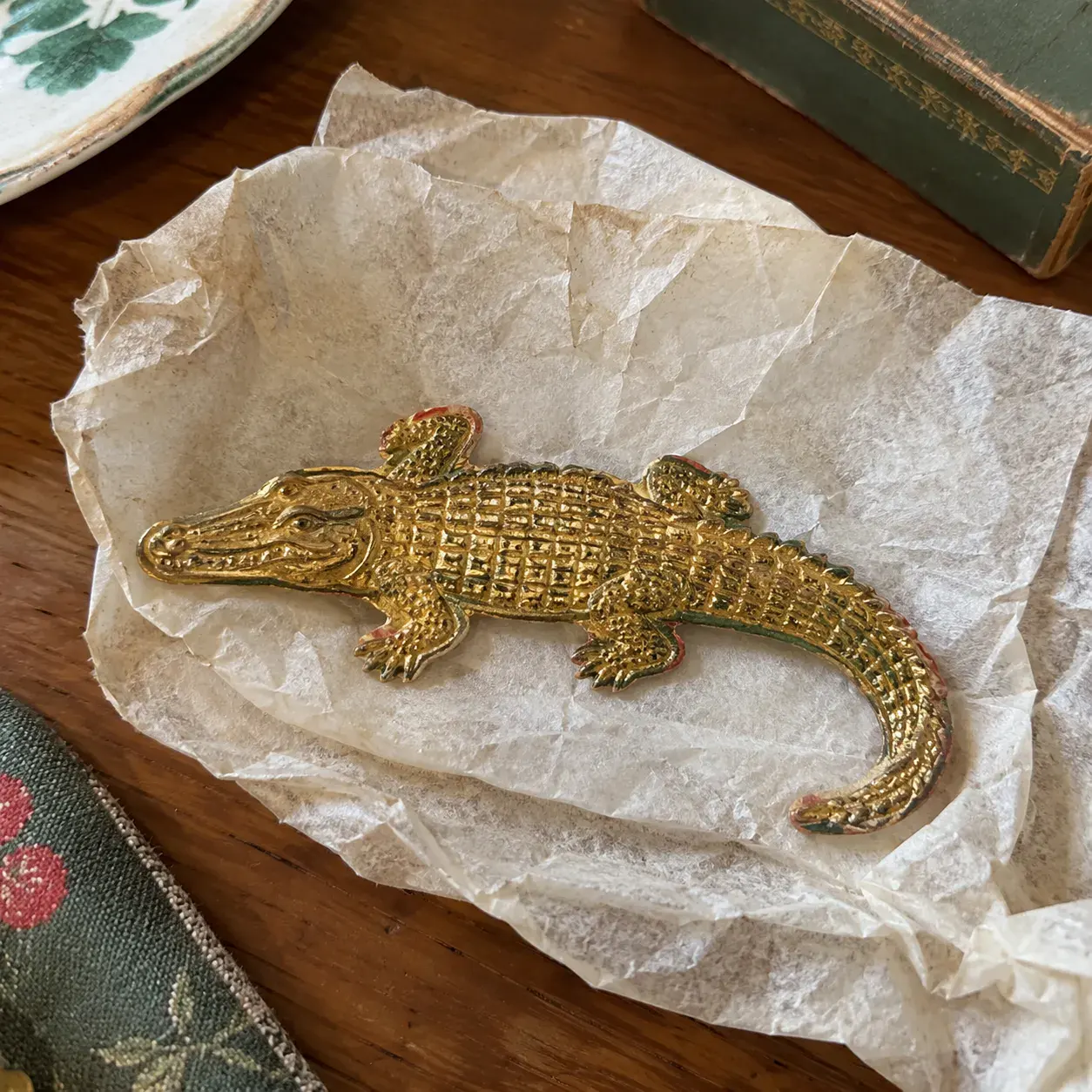
They look like stamped metal. They’re cardboard.
Dresden ornaments, named for the Dresden-Leipzig area of Germany, were mostly made between 1880 and 1910. Dampened cardboard was pressed in a die, then assembled at home by cottage workers. Most were gilded or silvered and only 2 to 3 inches in size.
And the shapes? Polar bears, storks, peacocks, alligators. Ocean liners. An entire orchestra of musical instruments.
Many thousands were made and relatively few remain. So a little gold alligator at the bottom of the box has made it through more than a century of Decembers.
3. The Pickle
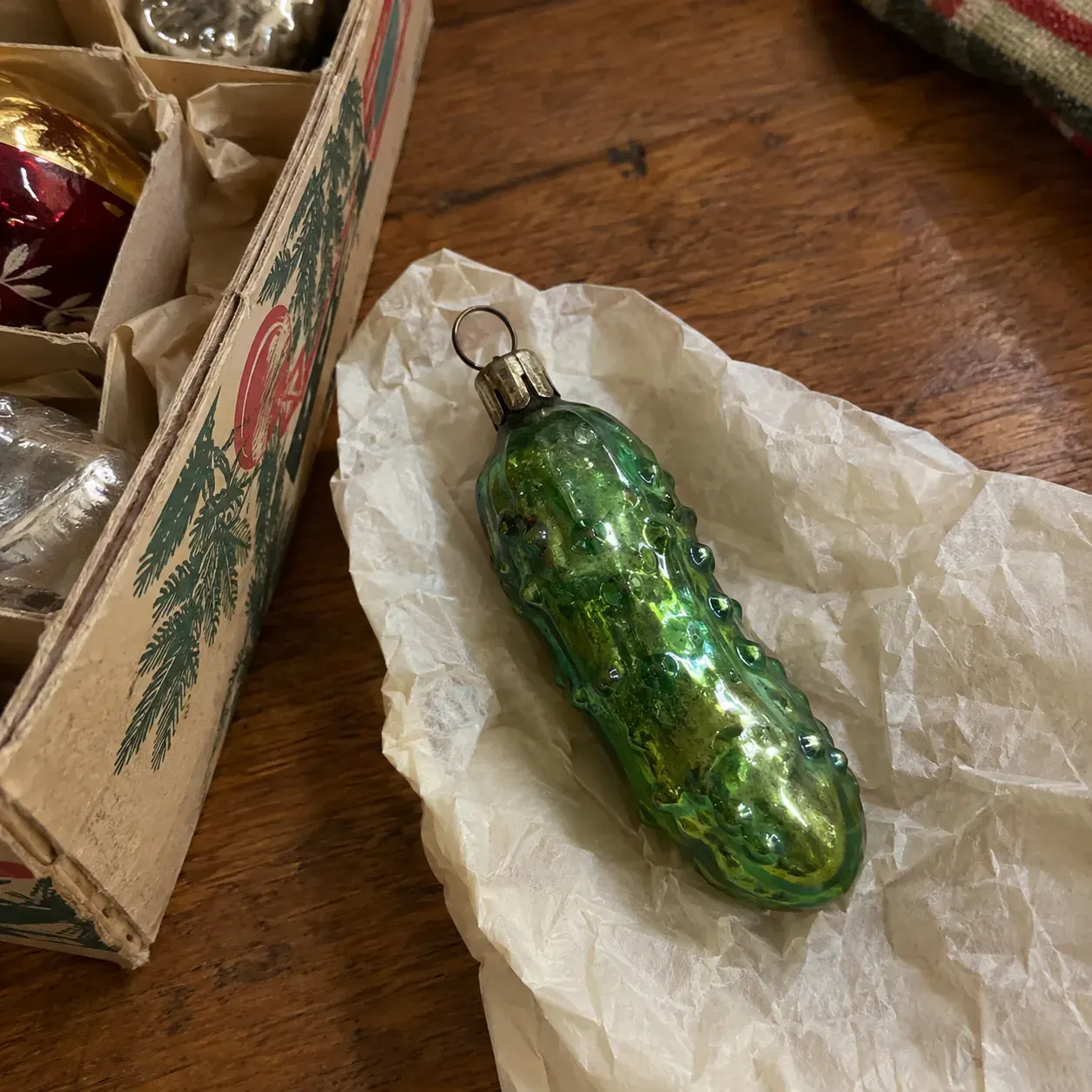
If there’s a glass pickle in the box, somebody probably told you it’s an old German tradition.
About nine in ten Germans surveyed in 2016 had never heard of it.
The pickle is thought to be a German-American custom from the late 19th century. Glass vegetables were a real import line, arriving from France from 1892 onwards, and one theory says salesmen invented the legend to move them.
Other tellings credit a starving Civil War prisoner who begged a guard for a pickle on Christmas Eve, or St. Nicholas rescuing two children trapped in a pickle barrel. Nobody has proved any of them.
None of that makes your family’s pickle a fake. It’s a real tradition in many German-American families. Its origins are still uncertain.
4. The Little Glitter Houses With a Hole in the Back
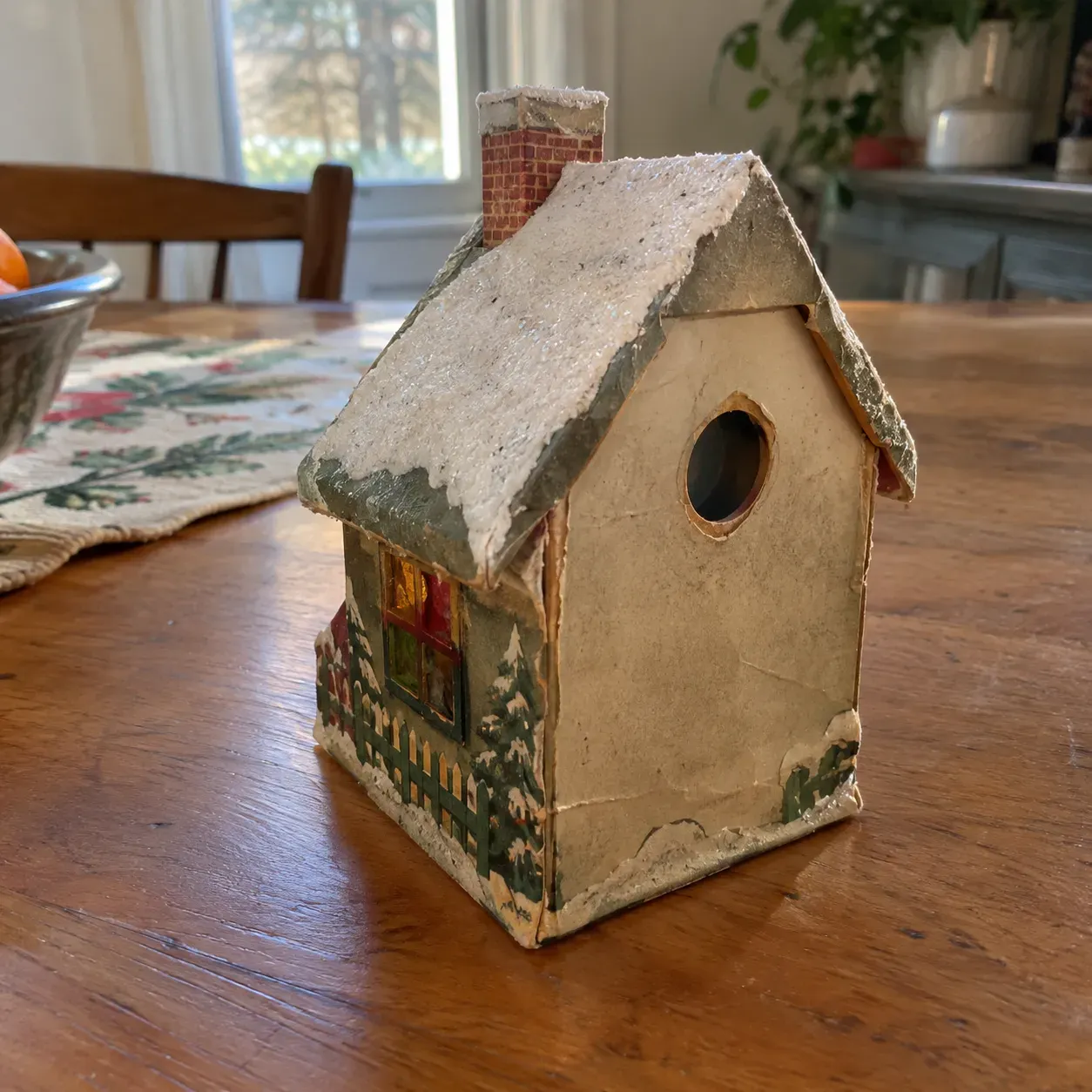
Tiny cardboard houses with colored cellophane windows and mica-dusted roofs began arriving around 1928, made in Japan for American dime stores. The hole in the back was for a Christmas light.
Who thought of putting a light in there? No one knows for certain.
They’re called putz houses, from the German verb putzen, “to clean” or “to decorate.” In early Moravian homes in America, a putz was the nativity scene built at the base of the tree.
World War II interrupted the trade, but Japanese companies also mass-produced these little houses after the war. Yours could have lit up a family Christmas on either side of that divide.
5. The Clear Ones With No Silver Inside
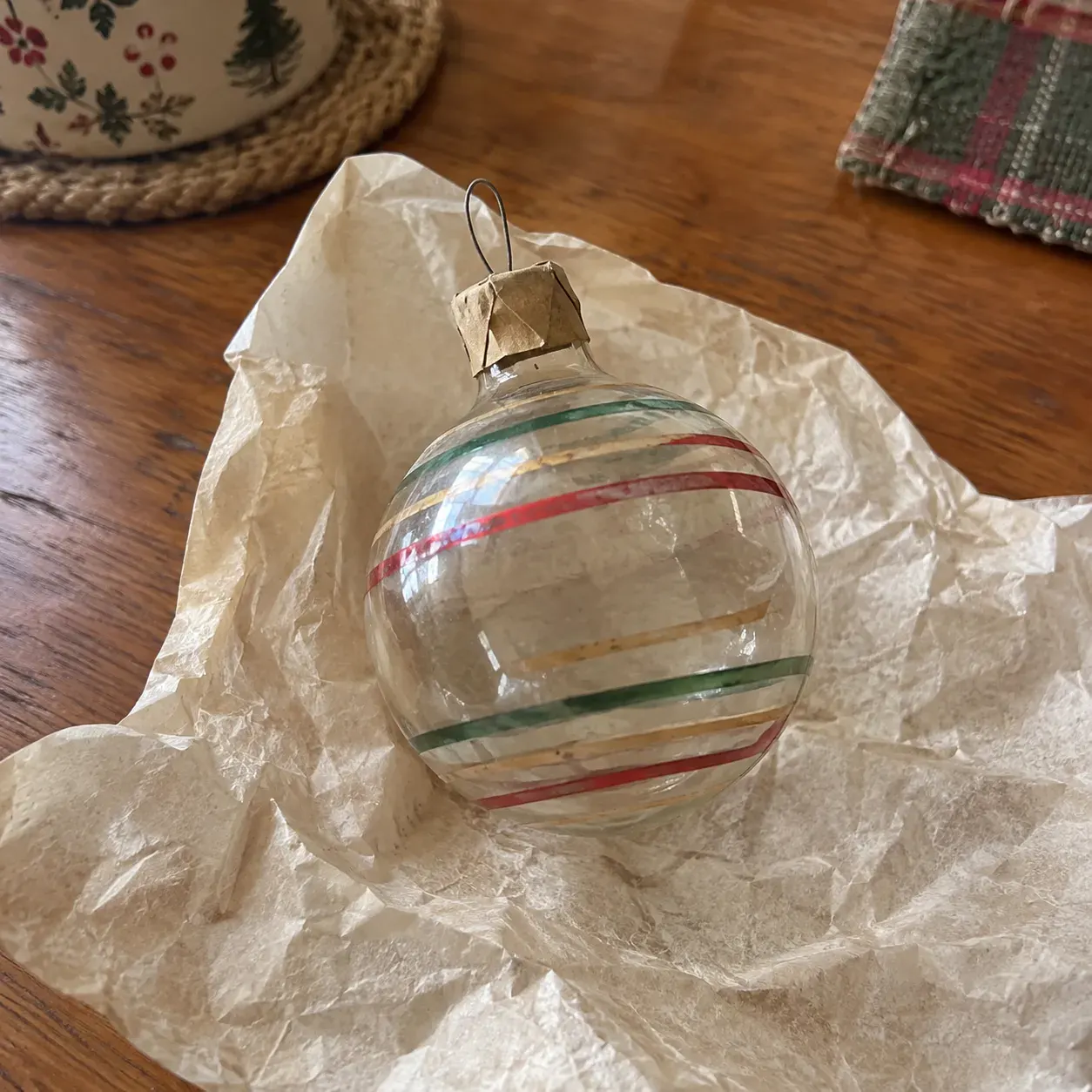
A see-through ball with a few painted stripes and a paper cap looks like the cheap one. It isn’t.
After the United States entered the war in 1941, the popular lacquers became impossible to import and most metals were diverted. So ornaments went out unsilvered. When nearly all American metal went to the war effort in 1942, even the caps gave way to folded cardboard hangers.
Silver lacquer and metal caps came back after the war ended in 1945. That clear ball was most likely bought during the war years. Somebody in your family wanted a tree anyway.
6. The Shiny Brites
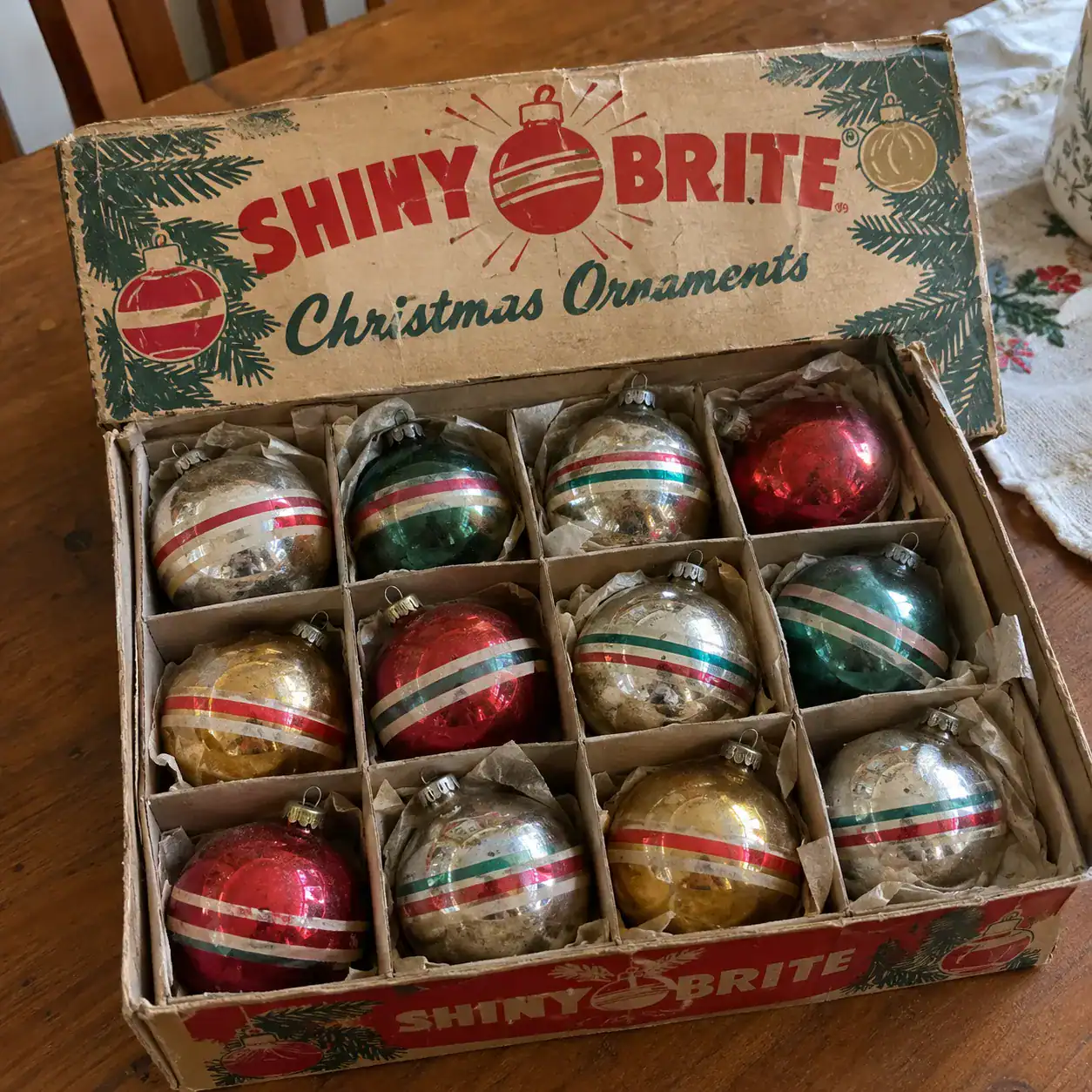
Max Eckardt was a German immigrant who had been importing ornaments since around 1907. In the summer of 1939, he and a Woolworth representative visited Corning Glass Works in New York.
Corning had a machine that made light bulbs. Within a few months, it was manufacturing more than half of the Christmas tree decorations sold in the United States.
By 1940, Corning was producing about 300,000 blank ornaments a day, against 600 for one glassblower in Lauscha. Eckardt’s New Jersey plants decorated them with silver lacquer inside and colored dye outside, and sold them as Shiny Brite.
By the 1950s, one Corning machine could turn out 1,000 a minute. The ornament on the tree and the bulb in the lamp came off the same kind of machine.
7. The Tinsel You’re Not Supposed to Have
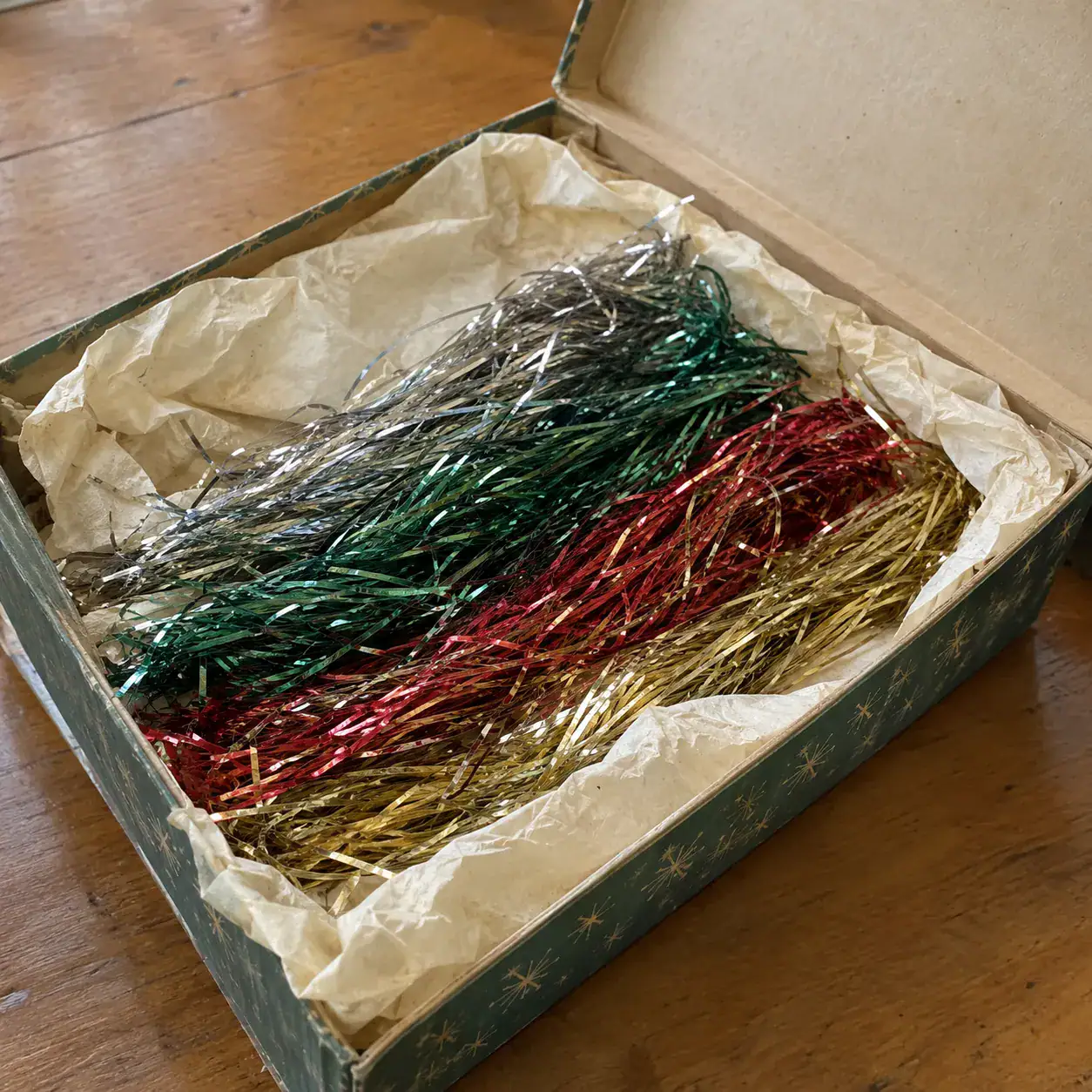
The first tinsel, in 17th century Germany, was real silver pressed into strips. It often tarnished before December 25.
Lead didn’t tarnish. For several decades of the 20th century, the heavy tinsel that hung dead straight off the branch was lead foil.
In August 1971, the Food and Drug Administration concluded that lead tinsel posed an unnecessary risk to children. Manufacturers and importers agreed to stop after January 1, 1972, and plastic took over.
Plenty of people will tell you the plastic kind never hung the same, which is why families saved the old strands one by one. If yours drapes like metal, it may be lead, and it’s best kept away from kids and pets.
8. The Yarn Santa With a Year on It
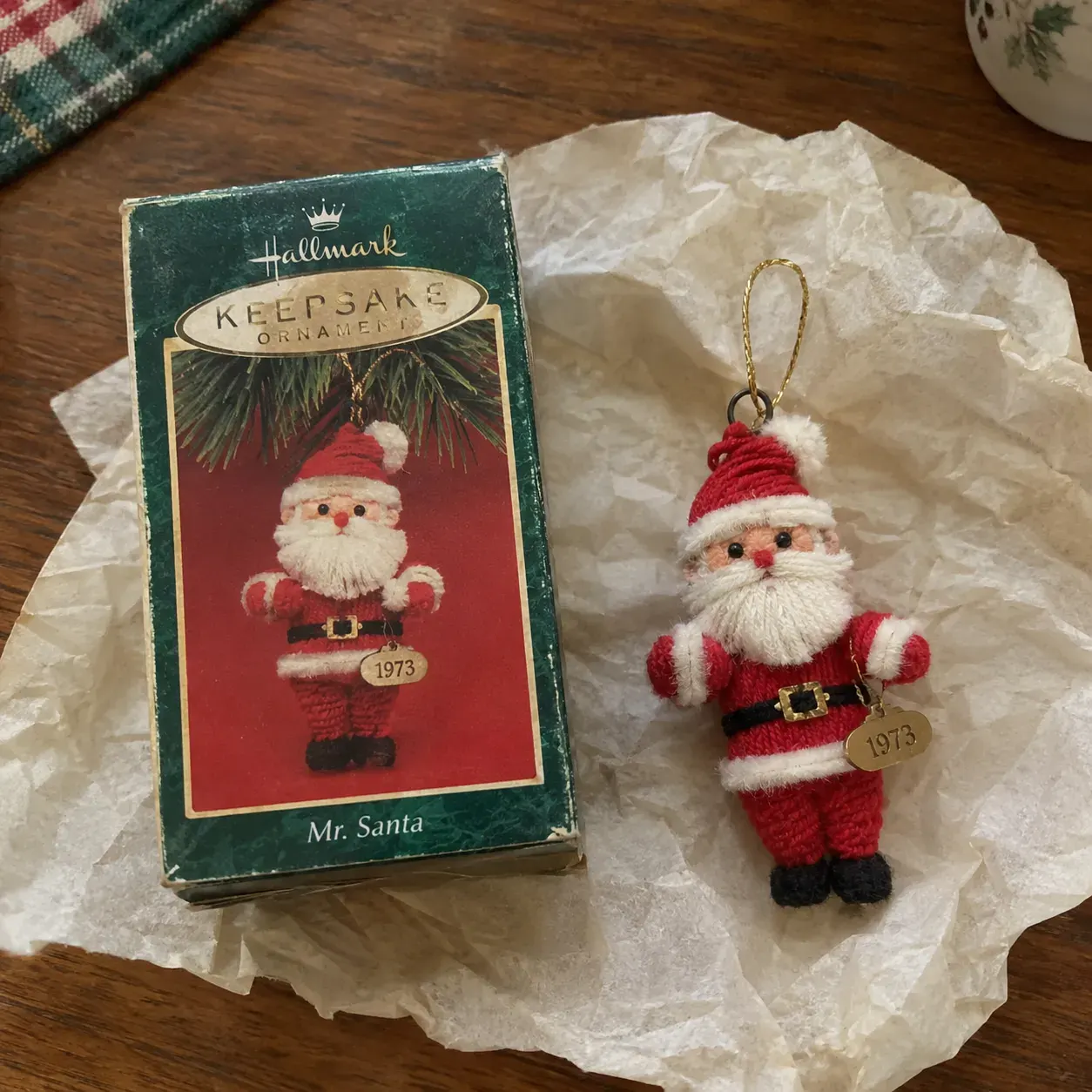
In 1973, Hallmark introduced 18 Keepsake Ornaments: six decorated glass balls and 12 yarn figures, including Mr. Santa, Mrs. Santa, an Elf, a Choir Boy and a Soldier.
They were year-dated, and that was new.
This is the point in the box where the ornament starts carrying the date itself. A year on an ornament can mark a birth, a first Christmas, a wedding. Everything older needs someone to tell you.
Ask Before the Box Gets Passed Again
You can put a rough date on glass, cardboard and tinsel. You can’t recover who hung it first once the person who knows is gone.
So this year, when the box comes out, ask the oldest person in the room which ornament they remember first. Write the answer on a slip of paper and put it back in the box.
The next person to lift that lid will inherit the story too.