

On September 15, 1954, a truck parked beside the grandstand at the Wayne County Fair in Ohio and gave free chest X-rays to anyone who asked.
That’s the county fair your grandparents knew.
By 1952, 4-H had 2 million members in 85,000 clubs, and the fair was where a lot of them showed their work. A man who remembers Oregon’s Baker County Fair called the 1950s “pretty much the heyday.” The war was over, people had money to spend, and more of them came.
It was the one week the whole county shared. It was also much stranger than the postcard version.
Here’s the day, morning to midnight.
1. Got the Day Off School to Go
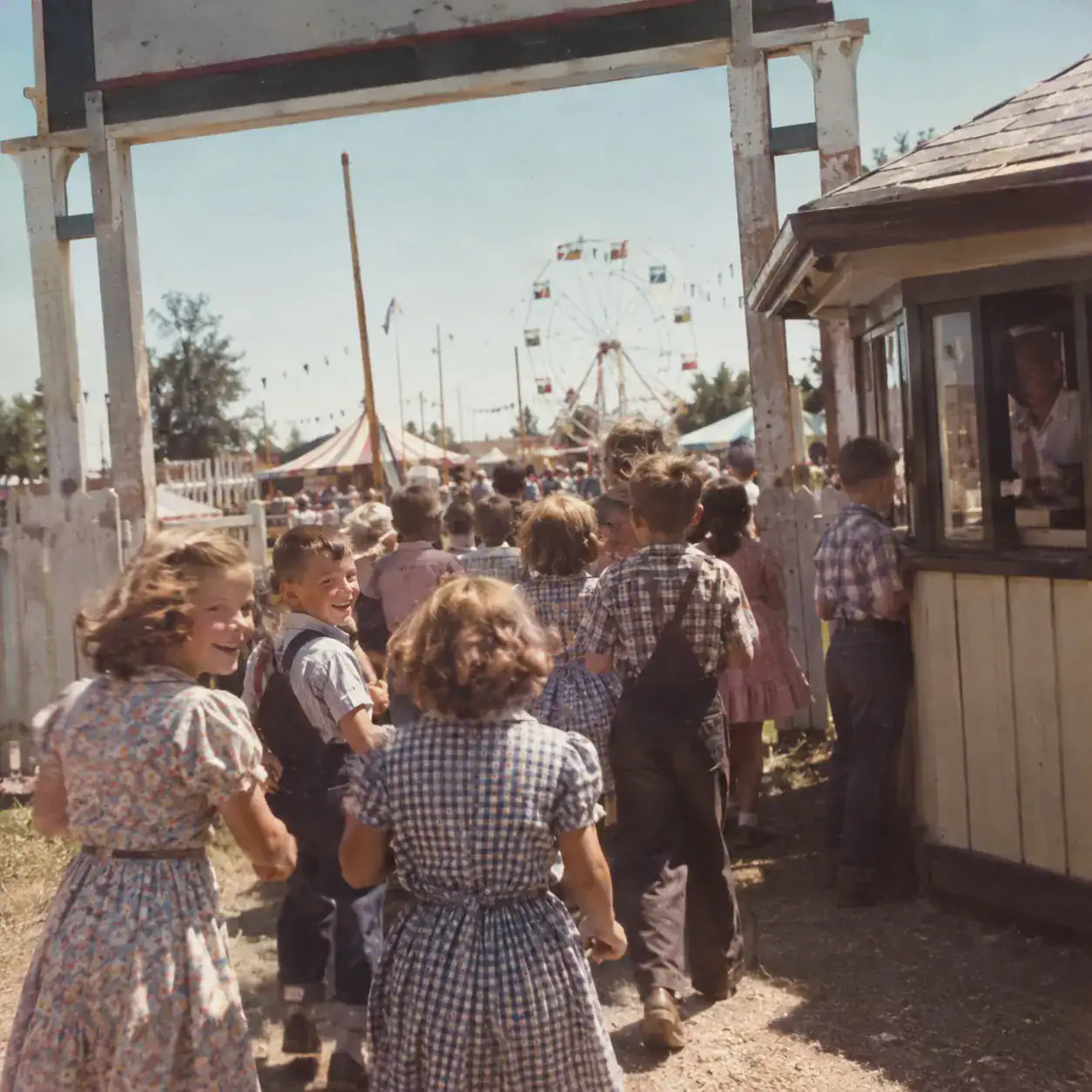
Many fairs set aside a School Day when kids got in free. In some counties, schools closed for it.
It wasn’t one shared day everywhere. South Carolina fair ads from 1951 and 1952 listed separate days for white and Black children.
2. Showed an Animal They Raised Themselves

4-H stands for Head, Heart, Hands and Health, and the fair was where a kid’s work got judged.
At Iowa’s Clay County Fair, the boys had their own dormitory on the grounds, built in 1947.
3. Sold That Animal at Auction

Then came the hard part. Coles County, Illinois, held its first 4-H auction on July 27, 1957, and sold 24 steers.
Picture being the kid who walks an animal you raised into the sale ring.
4. Put Their Canning and Needlework Up for a Ribbon

In Effingham County, Georgia, handwork, food and canned goods competed for ribbons and cash. Montana club women showed off their crafts in county fair booths.
Got a faded ribbon in a family drawer? This is the kind of place it came from.
5. Watched Harness Racing From the Grandstand

Horses pulling drivers in sulkies (light two-wheeled carts) raced at county fairs as early as 1825.
In Lyon County, Minnesota, the fair track was built for it. It stayed popular until the middle 1950s.
6. Stayed for the Jalopy Races on the Same Track

When the horses faded in Lyon County, cars took over the track.
In Ulysses, Kansas, the Grant County Fairgrounds got a track in 1951 for jalopies (old, beat-up cars). By 1956, crowds ran between 800 and 1,200.
7. Held Their Breath at the Thrill Show

Joie Chitwood took over a touring auto stunt show in the 1940s and ran five units across North America. Ramp-to-ramp jumps. Cars driven on two wheels.
Evel Knievel credited the show as his inspiration.
8. Saw an Early Demolition Derby

If your grandparents saw one in the ’50s, they were early. Nobody agrees who invented it. One claim says California in 1947, another says New York in 1958.
It didn’t become a county fair standard until the 1960s.
9. Argued Over Whose Horses Could Pull the Most

At the Baker County Fair, huge draft horses dragged sleds loaded with sacks of sand or cement. More went on until the horses couldn’t pull.
Most pounds won.
10. Climbed Onto the Sled at the Tractor Pull

Tractor pulling caught on across the rural Midwest and South in the 1950s and 1960s, and the rules changed from county to county.
One method used people as the weight. They stood at fixed spots and stepped aboard as the sled dragged past. Was Grandpa ballast? Maybe.
11. Rode the Tilt-A-Whirl

Herbert Sellner invented it in 1926 in Faribault, Minnesota. The first 14 were built in his basement and yard.
By the 1950s it was already an old favorite. Hundreds still operate.
12. Lined Up for a Brand-New Ride Called the Scrambler

At the 1955 Florida State Fair, one of its first major showings, the Scrambler took in $1,700 in a single day at 25 cents a ride.
That’s 6,800 rides.
13. Won a Plaster Prize on the Midway

Before stuffed animals, the prize was chalkware: molded plaster Kewpie dolls, animals and cartoon stars that wholesaled for around a dollar a dozen.
Plaster was on its way out in the ’50s, and the teddy bear was moving in. Some of those figures are still sitting in attics.
14. Paid to See Ten Acts Under One Tent

The “ten-in-one” meant ten acts for one admission price. Think sword swallowers, fire eaters and knife throwers.
These shows also exhibited people with physical differences. That, plus television, is why they faded.
15. Walked Past (or Into) the Girl Show

Many carnival midways carried one, with acts ranging from fully clothed revues to far less.
Ohio’s Wayne County Fair lists “dancing girls” among its past attractions. Call it the tent Grandpa never mentioned.
16. Watched Motorcycles Ride a Vertical Wall

The Wall of Death was a motordrome, a wooden barrel-shaped track. Riders circled the vertical wall while the crowd looked down from the rim.
The first carnival motordrome appeared at Coney Island in 1911. They were still touring midways decades later.
17. Ate Dinner on a Stick

The Pronto Pup was advertised as “a banquet on a stick for 15 cents.” In 1947, its first year at the Minnesota State Fair, one family sold 106,000 of them.
Plain or mustard. No ketchup.
18. Got a Free Chest X-Ray

Back to that truck. The 1954 photo caption calls it the “X-Ray-mobile.” Mobile units like it toured the country hunting for tuberculosis.
So the day could go: Tilt-A-Whirl, chest X-ray, Pronto Pup.
19. Crowned a Fair Queen

Plenty of fairs picked a queen. A Kentucky historical society still holds a photo of Shelby County Fair Queen contestants from around 1955.
Queens and their courts got photographed and named in the local paper.
20. Saw a Future Legend on the Fair Stage

At age 10, Elvis Presley sang “Old Shep” in the talent contest at the Mississippi-Alabama Fair and Dairy Show in Tupelo. He came in fifth.
On September 26, 1956, he came back to the same fair and played two shows for thousands. The fair stage was where rising acts played.
The Fair Left Paper Behind
Ribbons, queen photos, results columns in the local paper, and premium books (the fair’s printed list of contests and prizes). A lot of it has names on it.
So ask the relatives who were there which of these 20 they did. Then go looking for your family’s name in old fair coverage.
You might find out Grandma’s canning took a ribbon.