

In 1933, Halloween vandalism got so bad that some American cities considered banning the holiday.
That year was nicknamed “Black Halloween.” Hundreds of teenage boys flipped cars and sawed down telephone poles.
So the Halloween your grandparents knew, depending on when they were born, mixed old customs with new ones. Much of it was being invented around them, often by adults who just wanted the outhouse left upright.
Here are 20 of those traditions, from the prank years to the TV years. How many does someone in your family still remember?
1. Saying “Trick or Treat” When It Was Still New
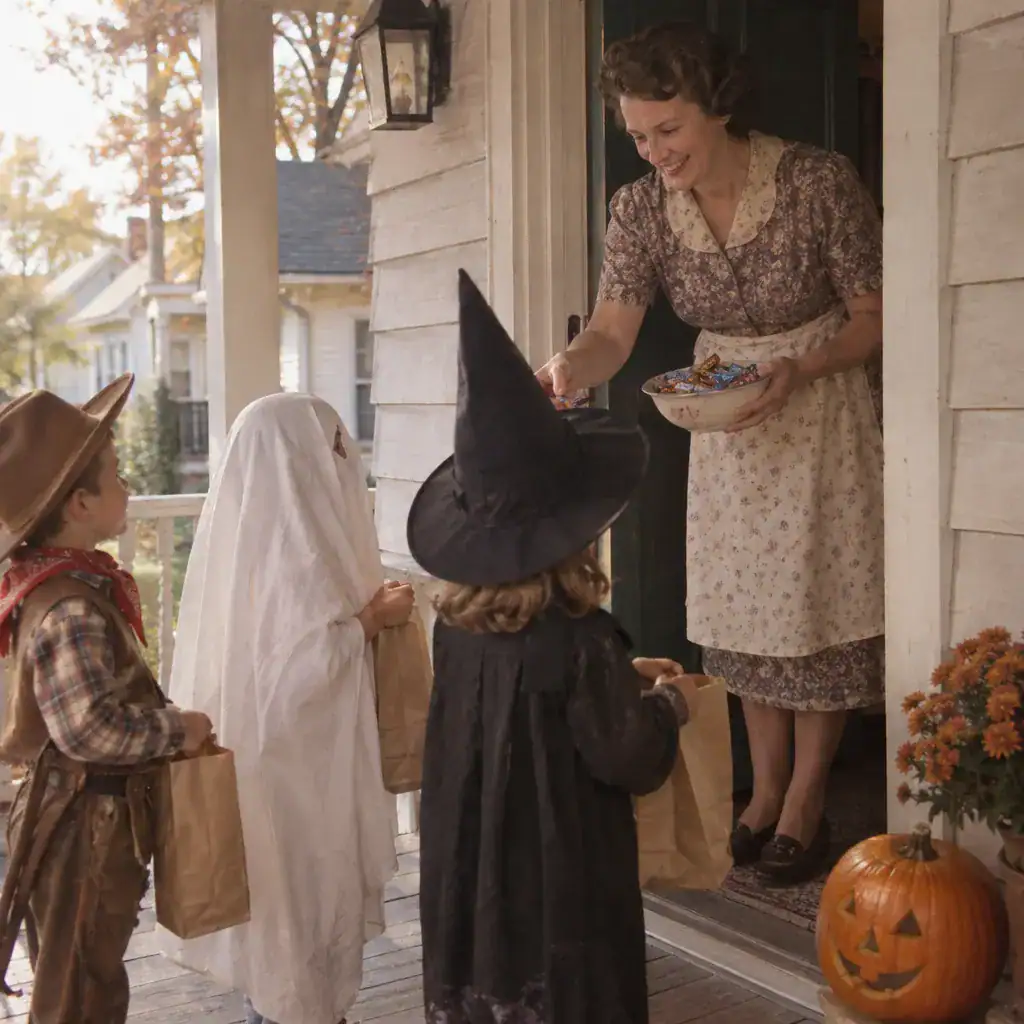
The earliest known printed examples come from Canadian newspapers in the 1910s and 1920s. In the U.S., trick-or-treating only became widespread after World War II.
By 1952, Donald Duck had a cartoon short named after it.
2. Gate Night and the Tipped Outhouse

Some places called October 31 “Gate Night,” because so many gates were lifted off their hinges and the livestock wandered out.
Older rural pranks put farm wagons on barn roofs and tipped outhouses, occupied or not.
3. Soaped Windows

In 1919, residents of Anoka, Minnesota woke up to soaped windows, tipped outhouses and cows loose on Main Street.
4. Painting the Shop Windows Instead

Towns like Beacon, New York tried a trade. In October 1951, art teacher Frances Schipbanker led Beacon’s first window-painting contest, hoping kids who decorated the glass would be less likely to soap it.
First prize went to two boys, 12 and 14, for a witch against a harvest moon.
5. The Whole Town Marching Down Main Street

Anoka’s answer came in 1920, with one of the first community Halloween celebrations in the country: a parade, a bonfire and free candy. Police received no reports of pranks.
By 1928, an estimated 10,000 people attended. Except for 1942 and 1943, it has been held every year since.
6. The Basement “Trail of Terror”

Depression-era parents built homemade haunted houses to keep kids off the streets.
A 1937 party pamphlet told them to hang old fur and strips of raw liver on the walls. Yes, liver.
7. The Bedsheet Ghost

Boxed costumes were an expensive luxury during the Great Depression, so most families made their own. The goal was to hide who you were, using anything you could get.
Often that meant a white sheet.
8. Halloween on Ration Stamps

Sugar rationing started in May 1942 and didn’t end until June 1947. The initial allowance was half a pound per person a week.
So wartime treats were peanuts, coins, fruit and small toys. In Pittsfield, Massachusetts, children pledged not to vandalize, in support of servicemen abroad.
9. Popcorn Balls From the Neighbor’s Kitchen

Popcorn balls were a fixture of 1950s Halloween parties, and trick-or-treaters got them wrapped, along with homemade fudge, cookies and caramel apples.
Fear of tampered treats pushed all that aside. The fear was real. But sociologist Joel Best, with data going back to 1958, has yet to find a report of a child killed or seriously hurt by a contaminated trick-or-treat.
10. Candy Corn by the Scoop

Candy corn is said to have been invented in Philadelphia in the 1880s. In 1898, the Goelitz company started selling it as “Chicken Feed.”
It was a year-round penny candy first, and became the Halloween candy from the 1950s on.
11. Bobbing for Apples

This was a staple of 1950s home parties.
An older version was matchmaking. Girls secretly marked the apples, and the boy who caught yours in his teeth was supposedly your future.
12. Tossing an Apple Peel to Find Your Sweetheart

A young woman would peel an apple in one unbroken strip, toss it over her shoulder and check the floor. Whatever letter the peel formed was her future husband’s initial.
It’s an old tradition, the kind your grandmother may have learned from her own grandmother.
13. Crepe Paper Everything

In the 1910s and 1920s, the Dennison paper company sold Bogie Books, booklets of party ideas built on its crepe paper. One cost five cents in 1912.
14. Tin Noisemakers

Halloween noisemakers probably originated in Germany and became popular in the U.S. around the 1920s. By the 1950s they were tin, with colorful Halloween graphics.
They went out of fashion in the 1960s.
15. The Midnight Spook Show

From the 1930s to the 1960s, American movie theaters hosted spook shows: a magic act, a blackout with glowing ghosts flying over the audience, then a horror film.
One of the first, in 1929, ran on mirror tricks, fishing line and luminous cheesecloth. The shows played all year, but Halloween suited them.
16. Scary Stories on the Radio

“Lights Out” aired from 1934 to 1947, and “Inner Sanctum” from 1941 to 1952.
On October 30, 1938, Orson Welles aired “The War of the Worlds” as a Halloween episode. Newspapers reported a panic. Historians now think it was far smaller than the legend.
17. The Costume That Came in a Box
It was a plastic mask and a vinyl smock, sold in a box for about $1 to $3 in the 1960s.
Television drove it. In 1950, 9% of U.S. households had a set, and by 1960, 90% did. In 1966, the Ben Cooper company sold 2 million Batman costumes.
18. The Little Orange UNICEF Box

On Halloween 1950, near Philadelphia, Mary Emma Allison and her husband, the Rev. Clyde Allison, had children collect coins in decorated milk cartons. That first year raised $17.
By 1969, 3.5 million American children were trick-or-treating for donations. U.S. collections have totaled more than $175 million since.
19. Staying Up for the Late-Night Horror Host

In October 1957, 52 old Universal horror films were released to television as “Shock Theater,” Dracula and Frankenstein among them. Stations added costumed hosts, like Zacherley in Philadelphia.
Ratings in five markets rose anywhere from 38 percent to 1,125 percent.
20. “Monster Mash” and the Great Pumpkin

“Monster Mash” hit No. 1 on October 20, 1962, after four labels had turned it down.
In 1966, “It’s the Great Pumpkin, Charlie Brown” tied Bonanza as the No. 1 broadcast in that week’s Nielsen TV ratings. After Charlie Brown got rocks, viewers mailed candy to Charles Schulz and the studio.
Ask Before the Answer Is Gone
Many of these traditions took their familiar form within living memory, shaped by ordinary parents, teachers and shopkeepers. Someone in your family may still remember the year things changed.
So ask them this October. What did you wear? What landed in the bag? Who made the popcorn balls?
Then write it down.