The attic ladder comes down with a groan and a breath of cold air. I stand at the bottom and look up into the dark, and the smell reaches me first. Cardboard and attic, the same as every year.
I’m not going up tonight. Christmas is still a few weeks away. I just wanted to see the box.
It’s there near the hatch, marked in my grandmother’s handwriting. Inside is a cheap poinsettia tablecloth with a cranberry stain, a mended burn and creases set by hands that aren’t here anymore.
She’s been gone a long time. Her handwriting is still up there in the cold, waiting for me.
The box marked in her handwriting
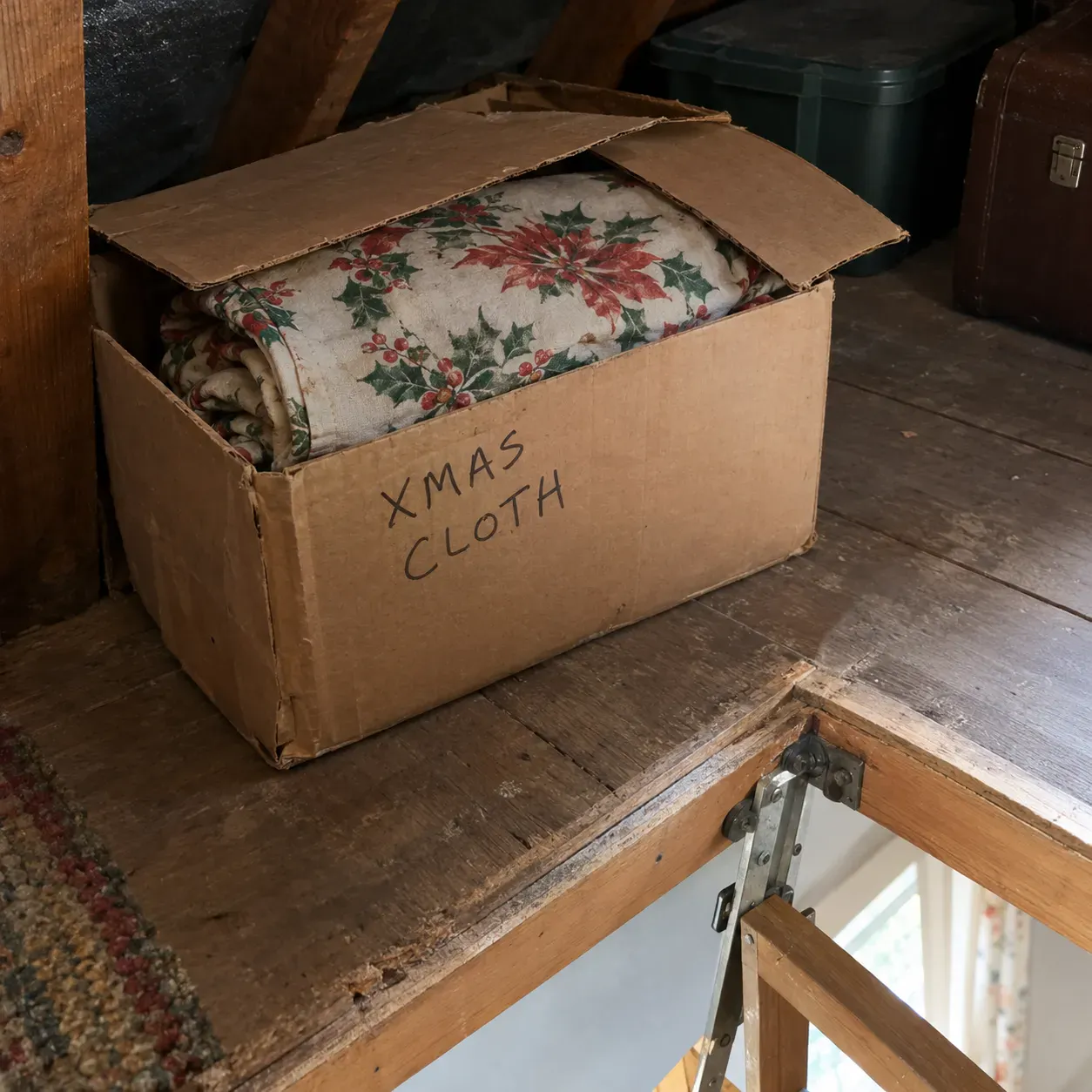
Her name was Ruth, and she bought the cloth for her first Christmas in her own house, after the war. The family story says 1947. My mother still thinks it was ’48, and nobody left can settle it.
What I remember is how Ruth put it on the table. She’d take two corners, lift her arms and snap it once, so it billowed up and floated down like a sheet on a clothesline. Then she’d walk the length of the table smoothing it with flat palms, tugging an edge here and an edge there, until the hem hung even at the chair backs.
I was about six the first time she let me hold a corner. I let go too early. She laughed and did it again.
That snap started before anyone at my table this year was born. Before my mother could walk. The cloth was already old when I first saw it, and it was already ours.
Poinsettias, holly, a cranberry stain
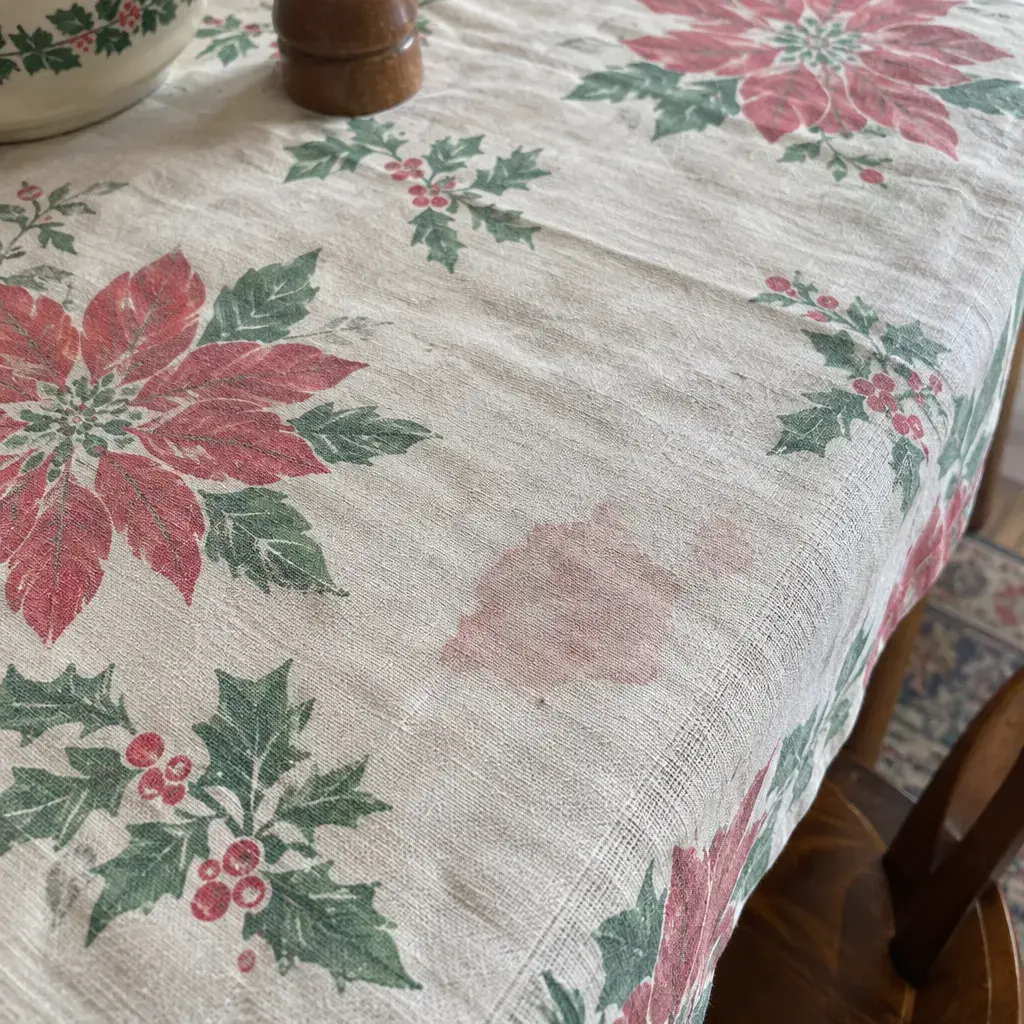
It isn’t fancy. Big red poinsettias on a white ground, with sprigs of green holly and clusters of berries running between them. The red has gone soft over the years, closer to watermelon than to fire.
It’s 52 inches square, which I know because I measured it once, the year I bought a new table and worried it wouldn’t fit. There’s no tag. There never was one that I remember.
Cloths like this were printed by the thousands and sold cheap, starting back in the Depression, a little cheer for not much money. Somebody in a factory made it to brighten a few holidays. It wasn’t made to last this long.
It lasted anyway, and it kept a record. Near one corner there’s a pale pink shadow shaped like a cloud. That’s the cranberry sauce my uncle knocked over reaching for the rolls, years before I was born.
He apologized for it at Christmas for the rest of his life. Someone always pointed at the spot so he’d have to.
On the opposite side there’s a darn about the size of a thumbnail, where a candle tipped and burned through. Ruth mended it with white thread in tiny crosshatched stitches. I can find it with my eyes closed.
Along one edge runs a long, pale stripe where the cloth sat closest to the dining room window, Christmas afternoon after Christmas afternoon, while the light did its slow work.
It was never meant to be an heirloom. It became one by being used.
Everyone who sat at its edges
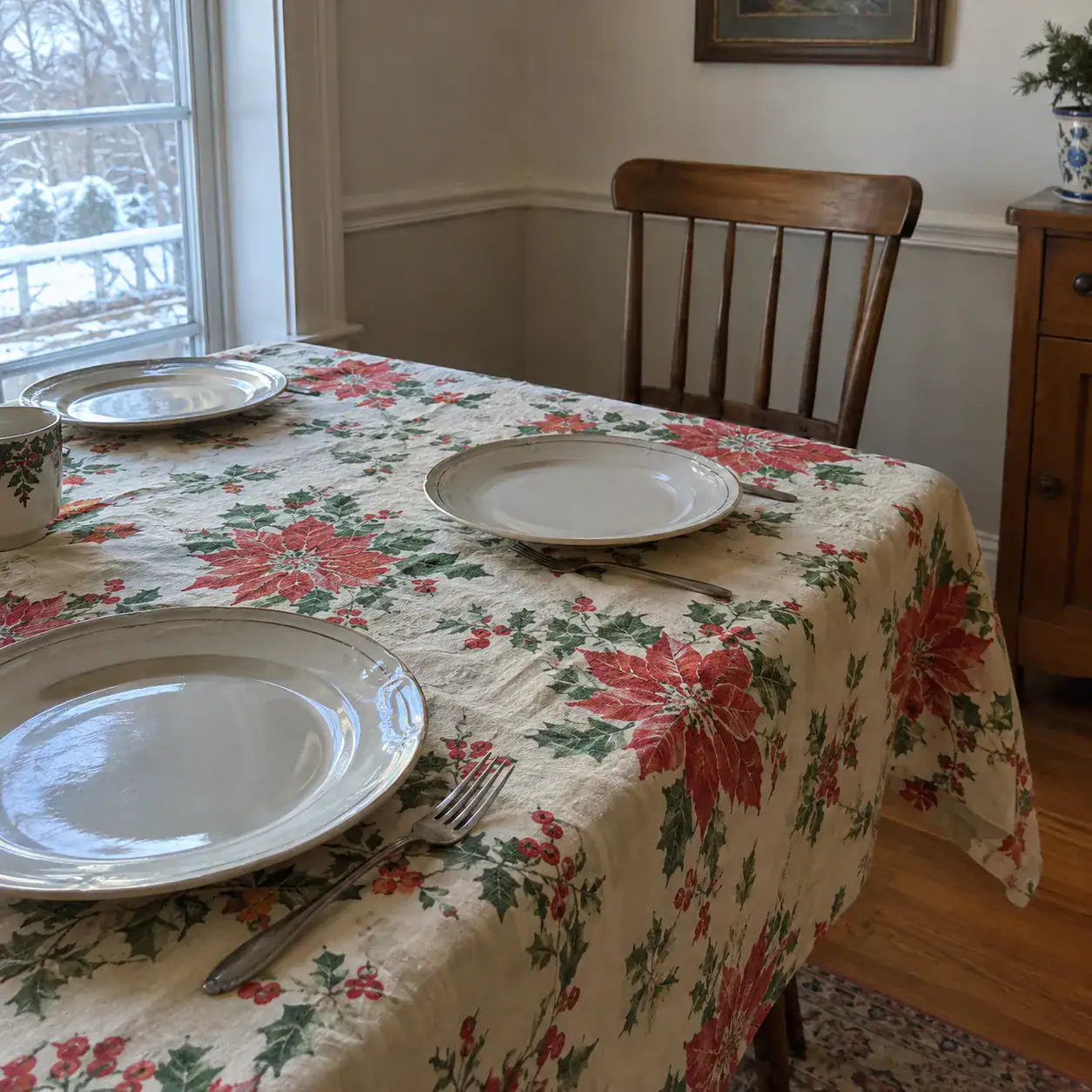
I can still set that table from memory. My grandfather at the head, carving, his sleeves rolled to the elbow. Ruth nearest the kitchen door, never quite sitting down. A card table pushed against the far end for the kids, covered in a plain white sheet because the Christmas cloth didn’t stretch that far.
I graduated from the card table the year I turned twelve. I remember the cloth under my elbows for the first time, the poinsettias right there beside my plate, and feeling enormous.
Then the faces started to change.
My grandfather died one spring when I was in high school. That December the cloth went on the table just the same. Ruth snapped it, smoothed it and pushed his chair back against the wall, and nobody said a word about the chair. We all looked at it anyway.
Years later it was my mother who lifted the corners, the first Christmas after Ruth’s funeral. She did the snap a little less sharply. Her hands shook when she smoothed the hem, and I pretended not to see.
The cloth was there for that one, too. It has been on the table in the years with a new baby passed hand to hand over the platters and in the years with an empty chair. It holds the people who were missing as surely as the people who came.
The fold lines
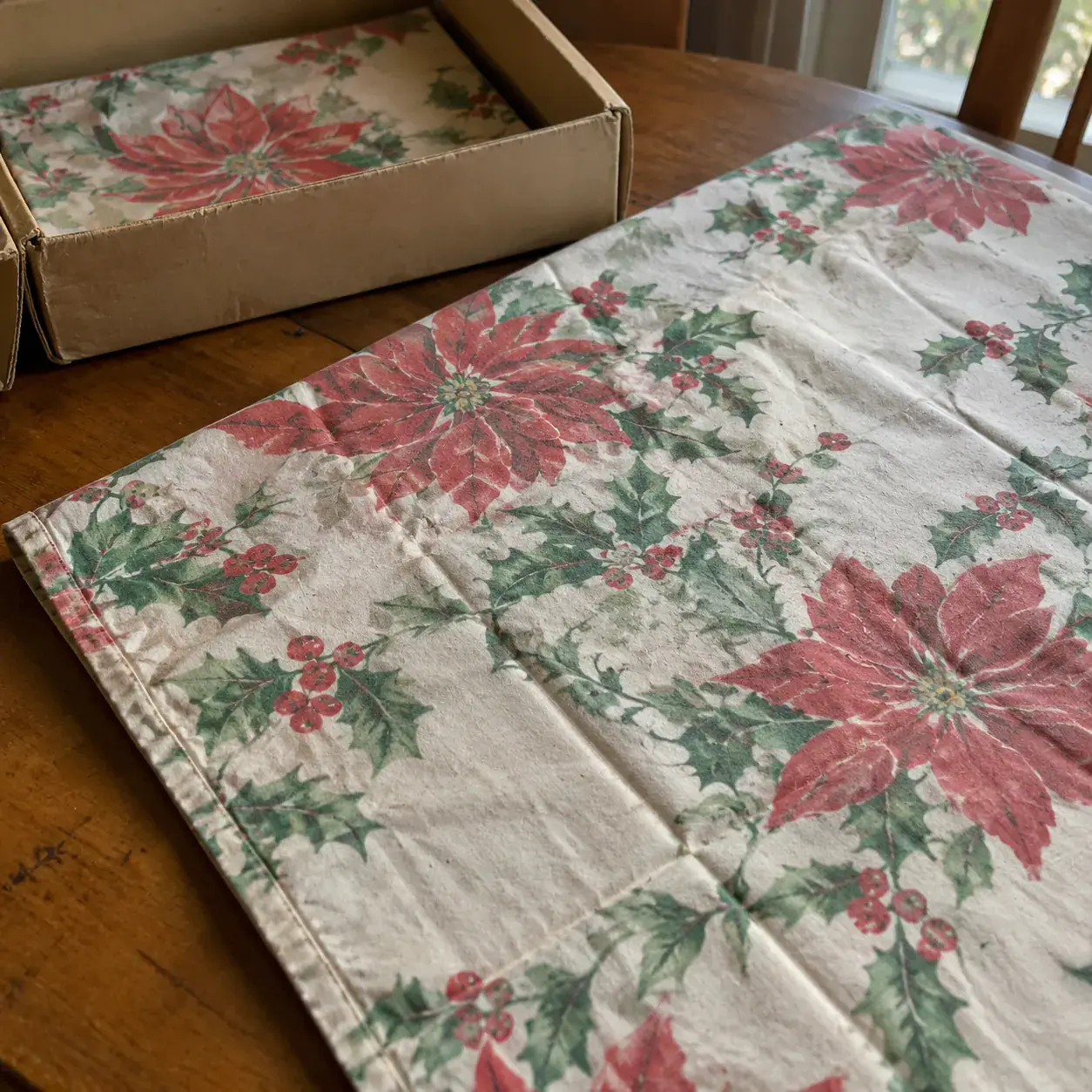
The cloth comes out of the box folded a particular way. In half, in half again, then in thirds, into a long flat packet that fits the box exactly. That’s Ruth’s fold. My mother kept it, and when she stopped hosting and the box came to my house, I kept it too.
After all these decades the creases have set into the cotton. When I spread the cloth out, a faint grid stays behind, like a street map laid over the poinsettias.
I’ve read the guidance written for old quilts. Strain builds up along the fold lines, and the people who care for old textiles say to change the fold now and then.
I tried, once. I folded it a new way, and it felt like moving the furniture around in Ruth’s house while she was out. The next year I put it back.
I know the attic is the wrong place for it, too. Heat and damp are hard on old cotton. It goes up there anyway, because that’s where Christmas lives in this house.
Those creases are where her hands went, year after year. A habit outlives the person who had it. It just moves into the things they touched.
Down the ladder
In a few weeks I’ll climb up there for real. I’ll hand the box down to my daughter, who will pass it to one of her boys, who will carry it to the dining room as if it were full of eggs.
I’ll lift the lid, and the smell will come out first. Cardboard and attic, and something underneath that I’d swear is Ruth’s kitchen, though I know it can’t be.
Then I’ll take two corners and lift my arms. Snap. The poinsettias will billow up and float down over my own table, the one it barely fits, and I’ll walk around smoothing it with flat palms until the hem hangs even at the chair backs.
My grandsons will sit at its edges this year. One of them will spill something.
I hope it’s the cranberry sauce.
What comes down from your attic
Yours might not be a tablecloth. It might be a chipped angel for the top of the tree, a gravy boat with a crack in the handle, or a recipe card gone see-through with butter, and it might live in a closet instead of an attic. It might be something nobody would look at twice at a yard sale.
Make a little room for it this Christmas.
Perhaps one day someone else will lift it from a box and be glad you kept it.
If someone at your table still remembers the years before you, Generational Journeys is an e-book of 170 interview questions to ask relatives. Start with the marks.